


Product introduction
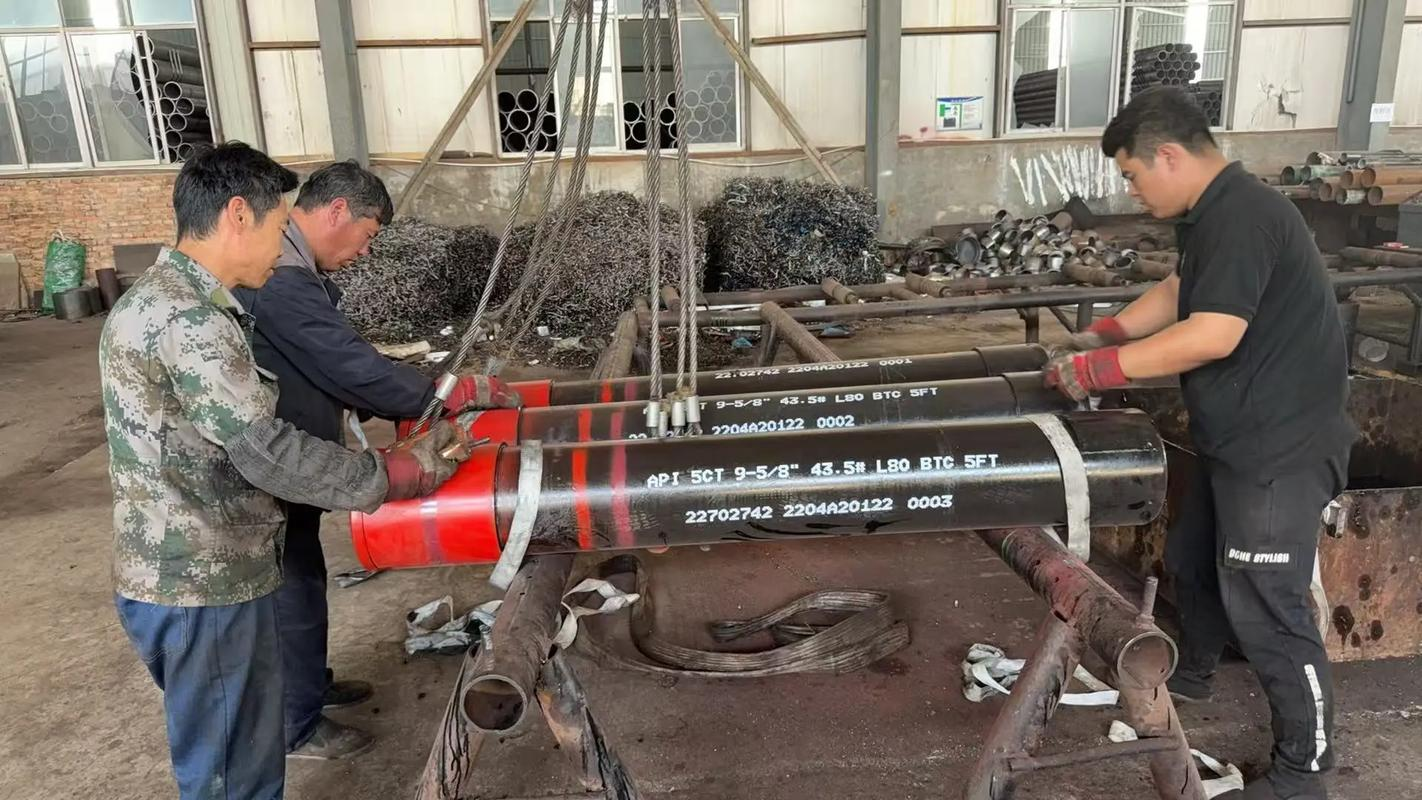
Grade L80 is a critical service grade designed specifically for corrosive environments. It shares the same 80 ksi minimum yield strength as N80 but is fundamentally different in its metallurgical design, manufacturing controls, and application. It is the primary choice when sour service (H₂S) or CO₂ corrosion is a design consideration.
L80 is not a single chemistry but a family of alloy steels defined by their performance in corrosive environments. Its composition is tightly controlled to achieve specific microstructures and corrosion resistance.
Base Chemistry for L80-1 (Standard for Sour Service):
| Element | Typical Range (%) | Maximum (%) | Purpose and Metallurgical Role |
|---|---|---|---|
| Carbon (C) | 0.15 – 0.30 | 0.35 | Significantly lower than N80. Reduces hardenability, ensures weldability, and minimizes formation of hard micro-constituents that promote cracking in H₂S. |
| Manganese (Mn) | 0.60 – 1.30 | 1.60 | Controlled level. Higher Mn increases hardenability, so it's limited to aid in achieving the required hardness cap. |
| Chromium (Cr) | 0.80 – 1.20 | 1.50 | The defining alloying element for L80-1. Added primarily to improve general corrosion resistance and increase hardenability in a controlled manner. It also enhances yield strength. |
| Molybdenum (Mo) | 0.15 – 0.30 | 0.35 | Essential for sour service. Strongly increases hardenability and, more importantly, greatly improves resistance to Sulfide Stress Cracking (SSC) by enhancing the stability of the tempered martensite microstructure. |
| Phosphorus (P) | - | 0.020 | Stricter limit than N80 (≤0.030%) to improve toughness. |
| Sulfur (S) | - | 0.010 | Very strict limit. Ultra-low sulfur is mandatory to minimize MnS inclusions, which are initiation sites for HIC (Hydrogen-Induced Cracking) in wet H₂S environments. |
| Silicon (Si) | 0.20 – 0.35 | 0.40 | Deoxidizer. |
Key Material Characteristics & Variants:
Mandatory Heat Treatment: All L80 grades are supplied in the Quenched & Tempered (Q&T) condition. This produces a uniform, fine tempered martensitic microstructure, which is essential for achieving the optimal combination of strength, toughness, and SSC resistance.
The "L80 Family":
L80-1 (Standard): The chemistry above. For general sour service (H₂S) with moderate CO₂.
L80-9Cr / L80-13Cr: Chromium-alloy grades for CO₂ corrosion resistance. They contain ~9% or ~13% Chromium, forming a stable Cr₂O₃ passive layer. L80-13Cr is the industry standard for severe CO₂ environments. They are also Q&T and have strict hardness control.
Sour Service Compliance: L80-1 is specifically designed and qualified to meet the requirements of NACE MR0175/ISO 15156 for sour service environments.
The mechanical properties of L80 are defined by strict upper and lower limits to ensure predictability and safety in corrosive service.
| Property | Specification / Typical Value | Comments & Engineering Significance |
|---|---|---|
| Yield Strength | Min: 80,000 psi (552 MPa) Max: 95,000 psi (655 MPa) | The maximum yield strength limit is the most critical difference from N80. This narrow band (80-95 ksi) prevents over-strength, which directly correlates to uncontrolled high hardness and susceptibility to SSC. |
| Tensile Strength | Min: 95,000 psi (655 MPa) | The minimum is set high to ensure an adequate yield-to-tensile ratio margin. |
| Yield-to-Tensile Ratio (Y/T) | 0.85 – 0.90 (Typical) | A controlled, moderate Y/T ratio indicates good ductility and strain capacity, favorable for burst/collapse performance and absorbing deformation. |
| Hardness | Maximum: 22 HRC (235 HBW) | The single most important property for SSC resistance. This strict global hardness cap is non-negotiable and is verified on both the pipe body and connections. It is the primary reason L80 can be used in H₂S where N80 cannot. |
| Charpy Impact Toughness | Often specified ≥ 40 J @ -20°C or lower | Sour service specifications frequently require demonstrably high impact toughness at low temperatures to ensure fracture resistance under dynamic loading. |
| Collapse & Burst Resistance | Predictable, design-friendly | Because the yield strength is bounded (80-95 ksi), the collapse and burst performance can be calculated with greater certainty than for N80-1, which has an unbounded upper yield. |
Critical Comparison with N80:
Strength: Both have an 80 ksi minimum yield. L80 adds a 95 ksi maximum yield.
Hardness: N80 can be >22 HRC; L80 must be ≤22 HRC. This is the legal/licensing boundary for sour service.
Microstructure: Both can be Q&T, but for L80 it is mandatory. L80's lower carbon content results in a finer, more stable tempered martensite.
Chemistry: L80 is an alloy steel (Cr-Mo), while N80 is a carbon/microalloy steel.
Purpose: N80 is for high strength; L80 is for strength + corrosion/SSC resistance.
Grade L80 is the corrosion-engineered counterpart to N80, sacrificing some ultimate strength potential for guaranteed environmental performance.
When to Use L80-1: For any downhole environment containing hydrogen sulfide (H₂S), regardless of concentration. It is the default choice for production tubing and casing in sour oil and gas fields. Also used when high chloride levels or other factors promote stress corrosion cracking.
When to Use L80-9Cr/13Cr: For wells with high partial pressures of CO₂ where weight-loss corrosion is the primary concern. 13Cr is standard for severe CO₂ corrosion; 9Cr offers a cost-effective solution for less severe conditions.
Material Selection Imperative: L80 and N80 are NOT interchangeable. Substituting N80 where L80 is specified for sour service is a fundamental design failure that will likely lead to catastrophic SSC failure. The codes and standards treat them as completely different materials.
Procurement Note: Ordering "L80" requires specifying the type: L80-1, L80-9Cr, or L80-13Cr. Mill certifications must be rigorously checked for chemistry, mechanical tests, and most importantly, hardness compliance (≤22 HRC).
Final Analogy: If N80 is a high-strength commercial truck built for tough loads on paved roads, L80 is an armored, explosion-proof vehicle built to carry valuable cargo through chemically hostile and potentially explosive terrain. The core strength is similar, but the protection systems are integral and non-negotiable.
Just like you, 70% customers choose long-term cooperation with BBN steel not only for our good product and service quality, good reputation in the international market, but also for our experienced one-stop raw material supply and further steel processing!
Shandong Chengda Steel Co., Ltd.
 Language

 Online Contact Us


