


Product introduction
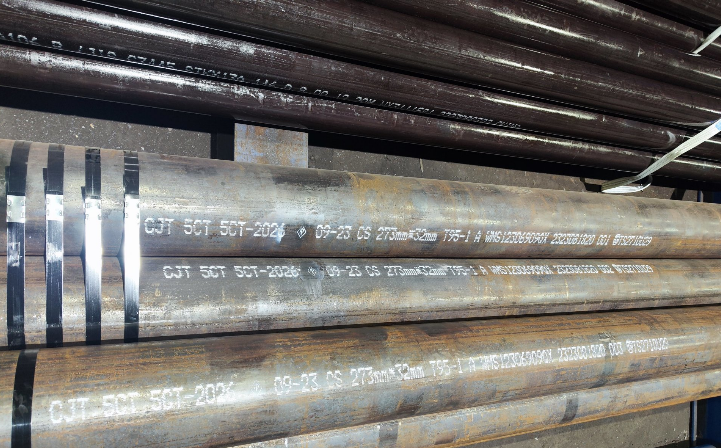
Grade T95 is a high-strength, sour service grade belonging to API 5CT's Group 2. It is engineered for deep, high-pressure wells where both exceptional mechanical strength and guaranteed resistance to Sulfide Stress Cracking (SSC) in hydrogen sulfide (H₂S) environments are required. It represents a critical capability for modern deep and sour reservoir development.
T95's chemistry is a carefully balanced alloy system designed to achieve high strength through hardenability while maintaining exceptional SSC resistance via microstructural control and cleanliness.
| Element | Typical Range (%) | Maximum / Key Limit (%) | Purpose and Metallurgical Role |
|---|---|---|---|
| Carbon (C) | 0.20 – 0.30 | 0.35 | Carefully optimized. High enough to contribute to 95 ksi strength via martensite formation, but low enough to ensure good weldability and a stable, SSC-resistant tempered microstructure. |
| Manganese (Mn) | 0.75 – 1.20 | 1.30 | Controlled to aid hardenability for Q&T processing while avoiding excessive segregation and austenite retention. |
| Chromium (Cr) | 0.80 – 1.20 | 1.50 | Enhances hardenability, provides moderate corrosion resistance, and improves tempering stability of the martensite. |
| Molybdenum (Mo) | 0.40 – 0.70 | 0.85 | Critical element. Strongly increases hardenability for heavy walls and, most importantly, dramatically improves SSC resistance by refining carbides and enhancing tempering resistance. Higher Mo content than L80 is typical for T95. |
| Phosphorus (P) | - | 0.020 | Very low limit to maximize toughness and minimize segregation. |
| Sulfur (S) | - | 0.010 | Ultra-low sulfur is mandatory. Essential to prevent Hydrogen-Induced Cracking (HIC) and Sulfide Stress Cracking (SSC) by minimizing MnS inclusion sites. |
| Microalloying (V, Nb) | ≤ 0.06 | - | Often used for grain refinement and precipitation strengthening, contributing to strength without drastically increasing carbon content. |
Key Material Characteristics:
Alloy Steel Design: T95 is fundamentally a Cr-Mo low-alloy steel, with molybdenum playing a more prominent role than in L80 to combat SSC at higher strength levels.
Mandatory Heat Treatment: Supplied exclusively in the Quenched & Tempered (Q&T) condition. This produces a uniform, fine tempered martensitic microstructure, which is the only structure capable of reliably delivering both 95 ksi yield strength and SSC resistance.
The Two Types:
T95 Type 1: The standard delivery condition for sour service.
T95 Type 2: Has additional, more stringent requirements (e.g., lower maximum yield strength, tighter hardness control, or supplemental testing) for the most severe sour service applications. Type 2 is often specified for critical production tubing.
Clean Steel Practice: Manufactured using advanced secondary steelmaking (e.g., ladle refining) to achieve ultra-low sulfur and controlled inclusion shape, ensuring high toughness and HIC resistance.
The mechanical properties of T95 are defined by a tightly controlled envelope to guarantee performance under the combined threats of high stress and H₂S exposure.
| Property | Specification / Typical Value | Comments & Engineering Significance |
|---|---|---|
| Yield Strength | Min: 95,000 psi (655 MPa) Max: 110,000 psi (758 MPa) | This narrow band (95-110 ksi) is crucial. It prevents the pipe from being under-strength (fails design) or over-strength (leads to excessive hardness and SSC failure). The upper limit is strictly enforced. |
| Tensile Strength | Min: 105,000 psi (724 MPa) | |
| Yield-to-Tensile Ratio (Y/T) | 0.90 – 0.95 (Typical) | Naturally higher than lower grades due to the high strength. It is closely monitored, as an excessively high Y/T (>0.93) can indicate reduced ductility and cracking risk. |
| Hardness | Maximum: 24.5 – 25.5 HRC (Typical) (~248 – 263 HBW) | This is the critical compromise. To achieve 95 ksi, hardness must be higher than L80's 22 HRC cap. T95's maximum is therefore set at a level (per NACE MR0175) that, when combined with its specific Cr-Mo chemistry and Q&T structure, still provides proven SSC resistance. Verification of hardness is paramount. |
| Charpy Impact Toughness | Often specified ≥ 40-60 J @ -20°C or -30°C | Deep, high-pressure wells can have low temperatures. High impact toughness is required to prevent brittle fracture during installation or pressure testing. |
| Collapse & Burst Resistance | Excellent | The high, predictable yield strength provides superior pressure ratings, making T95 suitable for the casing strings in deep, high-pressure formations. |
Critical Positioning within the Sour Service Family:
vs. C90: T95 and C90 are both 90-95 ksi sour service grades. C90 has a slightly lower maximum hardness (typically 24.0 HRC) and a slightly higher maximum yield strength (105-115 ksi depending on type). The choice between C90 and T95 is often dictated by operator-specific standards or regional preferences; both are engineered for severe service.
vs. L80: T95 provides ~19% higher minimum yield strength (95 vs. 80 ksi) for deeper/higher-pressure sour wells, at the cost of a higher, carefully managed hardness ceiling.
vs. P110/Q125: P110 is a non-sour, very high-strength grade. Q125 is an ultra-high-strength grade. Neither are suitable for sour service without special (and often impractical) modifications. T95 is the highest-strength, fully NACE-qualified, widely available sour service grade.
Grade T95 is the premier high-strength solution for deep, sour reservoirs.
Primary Application: For production casing and tubing in deep (e.g., >4,500m / 15,000 ft), high-pressure wells with medium to high concentrations of H₂S. It is also used for intermediate casing in severely corrosive overburden formations.
Key Driver: It allows engineers to design for high mechanical loads without sacrificing environmental cracking resistance. It bridges the critical gap between the strength of P110 and the sour resistance of L80/C90.
Procurement & Quality Assurance: Ordering requires specifying T95 Type 1 or Type 2. Mill certifications must be scrutinized for:
Chemistry (especially Mo content and S/P levels).
Hardness test reports proving compliance with the maximum limit.
SSC testing reports per NACE TM0177 Method A (tensile test in sour brine) are often a supplemental purchase requirement.
Limitation: Its higher hardness makes it more susceptible to SSC than L80 at a given H₂S partial pressure. Therefore, its use must be justified by well-specific environmental severity diagrams (ESDs).
Final Analogy: If L80 is a chemical-resistant industrial pump for harsh fluids, T95 is a high-pressure, corrosion-resistant subsea pump designed to operate at greater depths and pressures in the same hostile fluid. It is a specialized, high-performance tool for the most challenging downhole conditions where both immense force and chemical resistance are non-negotiable.
Just like you, 70% customers choose long-term cooperation with BBN steel not only for our good product and service quality, good reputation in the international market, but also for our experienced one-stop raw material supply and further steel processing!
Shandong Chengda Steel Co., Ltd.
 Language

 Online Contact Us


