



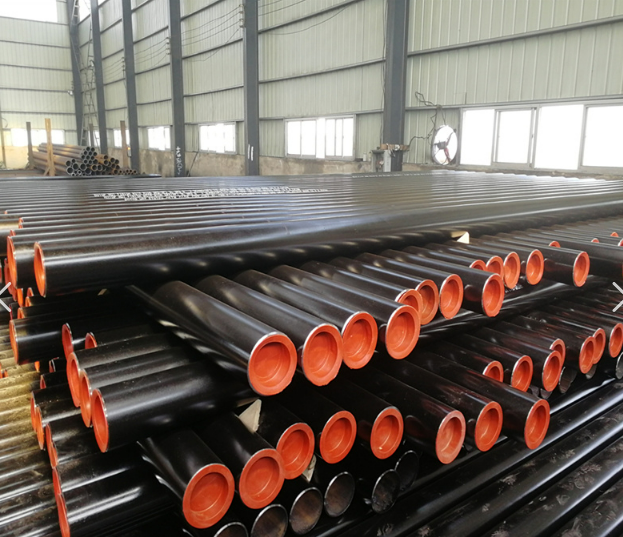
Product introduction
API 5L X70: Mechanical Properties and Chemical Analysis (PSL1 vs. PSL2)
API 5L X70 is a widely used high-strength pipeline steel with a specified minimum yield strength of 70,000 psi (483 MPa). It is a key technological choice for achieving higher operating pressures, larger diameters, and better cost-effectiveness. Particularly at the PSL2 grade, it represents the mature state of modern pipeline steel technology.
| Property | PSL1 Requirements | PSL2 Requirements | Key Differences & Engineering Significance |
|---|---|---|---|
| Specified Min. Yield Strength (SMYS) | ≥ 70,000 psi (483 MPa) | ≥ 70,000 psi (483 MPa) | The strength benchmark is the same, serving as the core design parameter. PSL2 requires stricter test verification. |
| Minimum Tensile Strength | ≥ 82,000 psi (565 MPa) | ≥ 82,000 psi (565 MPa) | Ensures structural integrity. PSL2 also controls the upper limit to maintain reasonable work hardening capacity. |
| Yield-to-Tensile Ratio (Y/T) | Not Specified | ≤ 0.93 (often stricter, e.g., ≤0.90) | Especially critical for X70. Maintaining a low Y/T ratio at high strength is more challenging. This is the fundamental safety guarantee against unstable fracture in overload or defect scenarios. |
| Impact Toughness | Not Required | Mandatory, High Requirements | PSL2 demands higher absorbed energy values and lower test temperatures (e.g., -20°C, -30°C, or even -40°C) to suit harsh environments like arctic or deep-sea regions. |
| DWTT Performance | Not required | Mandatory Requirement (min. 85% SA) | Core to fracture arrest design. Requires a high percentage shear area in the Drop Weight Tear Test at the specified temperature, ensuring effective crack arrest in case of ductile fracture propagation. |
| Hardness | Not required | Strictly controlled upper limit (e.g., ≤250 HV10). | Prevents weld cold cracking and Sulfide Stress Cracking (SSC) in sour service. For higher-strength X70, hardness control is a key focus in welding procedure qualification. |
Summary: PSL2 X70 imposes significantly stricter requirements on toughness, crack arrest capability, and yield-to-tensile ratio compared to X65, ensuring its intrinsic safety under high-stress conditions.
The chemical composition design of X70 revolves around a core challenge: how to achieve the unity of high strength and high toughness with very low carbon content through precise microalloying and advanced processing.
| Element/Requirement | PSL1 Chemistry (Typical Max. %) | PSL2 Chemistry (Typical Range/Limit %) | Design Philosophy & Metallurgical Role |
|---|---|---|---|
| C (Carbon) | ≤ 0.26 | 0.03 - 0.08 (Ultra-Low Carbon) | Foundation. Carbon is reduced to ultra-low levels (typically lower than X65) to maximize HAZ toughness and HIC resistance. |
| Mn (Manganese) | ≤ 1.45 | 1.55 - 1.85 | Key solid solution strengthener. Content is increased to compensate for strength loss from lower carbon, but limited by centerline segregation control. |
| P (Phosphorus) | ≤ 0.030 | ≤ 0.015 (Often ≤0.010) | Harmful element. Required to reach "high-purity steel" levels, essential for ultra-high toughness. |
| S (Sulfur) | ≤ 0.030 | ≤ 0.002 (Ultra-Low Sulfur, Ca-treated) | Achieved through secondary refining to ppm levels. Ultra-low S combined with Ca treatment controls sulfide morphology, greatly improving transverse toughness and HIC resistance. |
| Micro-alloying Elements | Not specified | Nb: 0.05-0.10, Mo: 0.15-0.25, Ti: 0.01-0.03, V: (Optional) | Core of alloy design. • Nb + Mo: Classic combination. Molybdenum promotes intermediate temperature transformation, synergizing with Niobium to form a high-strength, high-toughness acicular ferrite/bainite microstructure—key to achieving X70 properties. • Ti: Fixes nitrogen, refines cast structure. |
| Carbon Equivalent | No requirement | CE(Pcm) ≤ 0.22 or CE(IIW) ≤ 0.42 | Lifeline for weldability. CE, especially the Pcm value, is tightly controlled within a very low window to enable welding without preheat or with low preheat for thick-walled, high-strength X70 pipe during field construction. |
| Key Process | Conventional hot rolling or normalizing | Advanced TMCP or DQ Process | Employs lower finish rolling temperatures and more precise accelerated cooling control, or even Direct Quenching + Tempering (DQT) processes to obtain a uniform, fine ultra-low carbon bainitic microstructure, optimizing the strength-toughness combination. |
Overall Characteristics:
Balance of High Strength & High Toughness: Achieves excellent low-temperature impact toughness (often below -40°C) and crack arrest capability even at 483 MPa yield strength.
Excellent Weldability: Due to very low Pcm values, the field girth welding process window is wide, with good control over HAZ softening/hardening issues.
Environmental Adaptability: Can be tailored into sour service (X70MS), strain-based design (X70D), and offshore (X70MO) variants for demanding applications.
High Technical Barrier: Its performance heavily depends on the mill's capability in clean steel production, precise microalloying, and advanced TMCP process control.
Typical Applications:
High-pressure, large-capacity natural gas trunk lines (e.g., major national projects like West-East Gas Pipeline III).
High-demand pipelines in environmentally sensitive areas (arctic, deep-sea).
Crossing projects requiring reduced wall thickness to lower material cost and transportation difficulty.
Strategic pipelines for oil and gas storage and transportation.
Representative High Performance: API 5L PSL2 X70 is a high-end pipeline steel with large-scale commercial application, representing the peak of combined strength, toughness, and weldability.
Selection Core: Beyond standard requirements (yield strength, CVN, DWTT), it is essential to deeply scrutinize the chemical composition details, especially the actual content of C, P, S and the guaranteed range for the Pcm value. Furthermore, actual test data for the Yield-to-Tensile Ratio is critical.
Process & Certification: X70's performance is directly linked to the mill's process stability. Priority should be given to manufacturers with a proven track record of supplying X70 and a complete quality system. For critical projects, request a comprehensive performance data package based on Product Test Program (PTP) and strict third-party certification.
Design Compatibility: Using X70 typically implies the pipeline operates at higher design stress levels. Therefore, special requirements for fracture control, strain capacity, and welding procedures must be fully considered during the design phase.
Just like you, 70% customers choose long-term cooperation with BBN steel not only for our good product and service quality, good reputation in the international market, but also for our experienced one-stop raw material supply and further steel processing!
Shandong Chengda Steel Co., Ltd.
 Language

 Online Contact Us


