



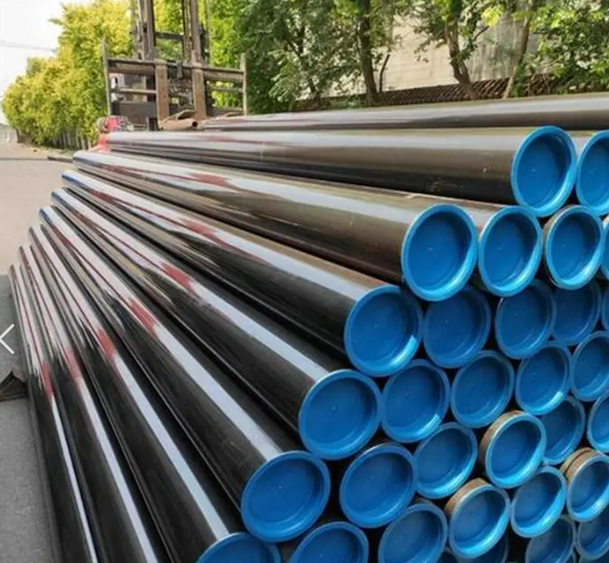
Product introduction
The core performance requirement for X80 lies in the triangular balance of "high strength, high toughness, and low yield-to-tensile ratio." Its PSL2 requirements are exceptionally stringent.
| Performance Indicator | Typical PSL2 Requirements & Range | Engineering Significance & Technical Challenge |
|---|---|---|
| Specified Min. Yield Strength | 80,000 – 100,000 psi (552 – 690 MPa) | Design baseline. Production must precisely control strength within the target range to avoid compromising toughness and weldability. |
| Minimum Tensile Strength | ≥ 90,000 psi (621 MPa) | Ensures load-bearing capacity. Sufficient work hardening capacity must be maintained alongside increased strength. |
| Yield-to-Tensile Ratio (Y/T) | ≤ 0.90 (Often required ≤0.88 or lower) | The lifeline of X80 safety. Maintaining a low Y/T ratio at ultra-high strength is the greatest challenge, directly determining the pipe's plastic deformation capacity and crack arrest performance at defect sites. |
| Impact Toughness | Extremely High Requirement | Required Charpy impact energy values are significantly higher than for lower grades, with test temperatures typically at -30°C or lower. Ensures no brittle crack initiation in arctic conditions or under dynamic loading. |
| DWTT Performance | 85% SA @ -10°C or Lower | Mandatory prerequisite for crack arrest design. Requires X80 pipelines to possess极强的 resistance to ductile fracture propagation, placing extremely high demands on the microstructural homogeneity of both base metal and weld joints. |
| Hardness | Strictly Controlled (e.g., HV10 ≤ 240) | Prevents weld cold cracking and hydrogen-induced cracking. A lower hardness上限 is essential for successful welding procedures. |
| Strain Capacity | (If applicable) Uniform elongation, strain hardening exponent required | For X80 pipelines in seismic or landslide zones, additional strain-based design requirements demand极限 performance in terms of material ductility and deformation capacity. |
Summary: The mechanical properties of X80 represent a systematic balancing act; excellence in any single indicator must not come at the cost of other critical safety parameters.
The chemical composition design of X80 is a precise exercise in metallurgical engineering. Its core strategy revolves around "ultra-low carbon, high manganese, composite microalloying, and purity control."
| Element/Requirement | Typical Range/Control Target (%) | Metallurgical Principles & Role |
|---|---|---|
| C (Carbon) | 0.03 – 0.06 (Ultra-Low Carbon) | The foundation of all design. Ultra-low carbon is the absolute prerequisite for achieving excellent low-temperature toughness, weldability, and HIC resistance, while also lowering the bainite start transformation temperature. |
| Mn (Manganese) | 1.80 – 2.10 | A core solid solution strengthener and key to stabilizing austenite and promoting bainitic transformation. High Mn compensates for strength loss from reduced carbon but requires精密配合 with cooling processes to prevent segregation. |
| Mo (Molybdenum) | 0.20 – 0.35 | A crucial alloying element. Strongly delays pearlite transformation, ensuring the formation of a uniform, fine ultra-low carbon bainite microstructure over a wide cooling range. This is central to achieving both high strength and toughness. |
| Nb (Niobium) | 0.05 – 0.10 | Core microalloying element. Achieves extreme grain refinement by inhibiting austenite recrystallization and through precipitation strengthening, significantly increasing strength without sacrificing toughness. |
| Ti (Titanium) | 0.01 – 0.03 | Fixes nitrogen, forming fine TiN particles that pin grain boundaries during continuous casting and reheating, inhibiting prior austenite grain growth. |
| V (Vanadium), B (Boron) | V: Trace; B: Very trace (0.0005-0.002) | Optional elements. V assists in precipitation strengthening; B significantly increases hardenability, working synergistically with Mo to ensure uniform through-thickness properties in heavy-wall pipe. |
| P (Phosphorus) | ≤ 0.010 (Target <0.008) | Highly detrimental impurity. Requires ultimate purity levels; any elevation severely damages toughness and HAZ properties. |
| S (Sulfur) | ≤ 0.001 (Ultra-low S, Ca-treated) | Requires ppm-level control. Combined with calcium treatment to spheroidize sulfides, this is the decisive factor for ensuring ultra-high transverse impact toughness and isotropy. |
| Carbon Equivalent | CE(Pcm) ≤ 0.20; CE(IIW) ≤ 0.40 | The absolute threshold for weldability. Extremely stringent control of CE (especially Pcm) is the only way to ensure that thick-walled X80 pipe can be field girth welded without preheat or with minimal preheat, while avoiding cold cracking. |
| Key Process | Advanced TMCP or DQ&T | Employs lower finish rolling temperatures, precise laminar cooling, or even Direct Quenching & Tempering (DQ&T) to achieve an ideal microstructure dominated by lath bainite. The process window is extremely narrow, demanding极高的 control precision. |
Characteristics:
极限 Performance Balance: Maintains卓越 low-temperature toughness and crack arrest capability even at a 552 MPa yield strength.
Stringent Weldability Requirements: Places extremely high demands on consumable matching, welding procedures (heat input, preheat temperature), and welder skill.
High-Technology & High-Cost Intensive: Every step from smelting and rolling to pipe-making and inspection requires top-tier technology and strict quality control, resulting in significantly higher costs than lower grades.
Defect Sensitivity: High strength makes the material more sensitive to geometric defects (e.g., gouges) and metallurgical defects (e.g., inclusions).
Typical Application Scenarios:
High-capacity, high-pressure natural gas trunk lines with critical economic drivers (e.g., the China-Russia Eastern Natural Gas Pipeline).
Pipeline projects requiring大幅 wall thickness reduction to address transportation and installation challenges in complex terrain (e.g., mountainous regions).
Strain-based design pipelines crossing active faults or permafrost regions (requiring X80D).
Deepwater high-pressure flowlines and trunklines (requiring X80MO).
Prioritize Performance Validation: Selecting X80 cannot rely solely on mill reports. It must be based on a complete, full-scale Product Test Program validating its DWTT performance, weld, and HAZ toughness for the actual pipe diameter and wall thickness.
Focus on Process Capability, Not Single Indicators: The supplier's process stability and historical track record are more important than承诺 data from a single heat. Review their continuous batch qualification rate for X80 production.
Adopt a Systemic Application Mindset: Successful X80 application is a systems engineering challenge involving:
Design: Employing strain-based design principles and conducting rigorous fracture and crack arrest control analysis.
Pipe Making: Considering the impact of forming, welding (e.g., JCOE/UOE), and expansion processes on base metal properties.
Construction: Mandating rigorous welding procedure qualification and ensuring precise control during field construction.
Specify Additional Requirements Clearly: Technical specifications must clearly define specific附加 requirements such as sour service resistance, strain capacity, and crack arrest toughness, along with corresponding test methods and acceptance criteria.
Just like you, 70% customers choose long-term cooperation with BBN steel not only for our good product and service quality, good reputation in the international market, but also for our experienced one-stop raw material supply and further steel processing!
Shandong Chengda Steel Co., Ltd.

 Language

 Online Contact Us


