



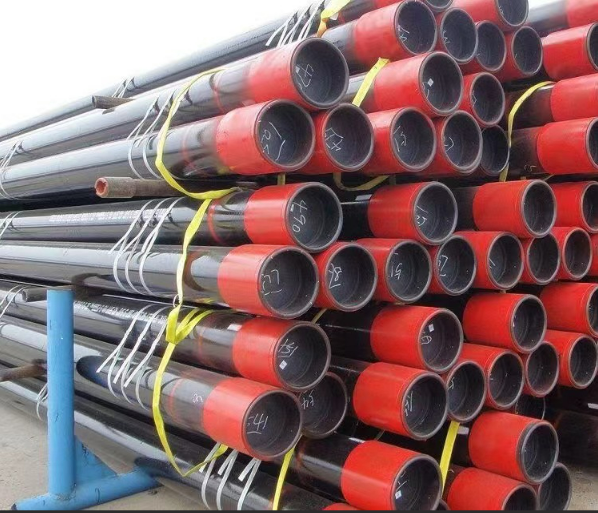
Product introduction
The API 5L standard specifications for X46 differ significantly based on the Product Specification Level (PSL).
PSL1 requirements are relatively lenient, suitable for non-demanding environments.
| Performance Metric | Requirement | Analysis |
|---|---|---|
| Yield Strength (Rp0.5) | ≥ 317 MPa (46 ksi) | This is the origin of the X46 designation. Moderate strength, higher than X42, lower than X52. Adequate for medium-to-low pressure transmission. |
| Tensile Strength (Rm) | ≥ 434 MPa (63 ksi) | Ensures the material has sufficient safety margin to prevent fracture. |
| Yield-to-Tensile Ratio (Rp0.5/Rm) | ≤ 0.93 | Limits the ratio of yield strength to tensile strength, ensuring the material has some plastic deformation capacity to prevent brittle failure. |
| Elongation (A) | As per standard, typically ≥ 22% | Guarantees the steel pipe has a certain degree of plastic deformation capability, beneficial for installation and forming. |
| Impact Toughness | Usually not a mandatory requirement | This is the most critical difference between PSL1 and PSL2. Risk of fracture is higher under low temperatures or impact loading. |
| Hardness | Usually not a mandatory requirement | - |
PSL2 substantially increases requirements for toughness and chemical composition homogeneity compared to PSL1, making it suitable for more critical pipelines.
| Performance Metric | Requirement | Analysis |
|---|---|---|
| Yield Strength (Rp0.5) | ≥ 317 MPa (46 ksi) | Same as PSL1. |
| Tensile Strength (Rm) | 448 - 600 MPa (65 - 87 ksi) | Specifies not only a lower limit but also an upper limit, allowing for more precise control over the strength range, which benefits welding and construction. |
| Yield-to-Tensile Ratio (Rp0.5/Rm) | ≤ 0.93 | Same as PSL1. |
| Elongation (A) | As per standard | Same as PSL1. |
| Impact Toughness (CVN) | Mandatory Requirement | Core differentiator. Charpy V-notch impact testing is mandatory and must meet specified minimum absorbed energy values (depending on wall thickness and service temperature). This greatly enhances the pipe's resistance to brittle fracture and crack arrest capability. |
| Hardness | Has a maximum hardness limit (e.g., ≤250 HBW) | Controlling hardness is primarily to prevent Hydrogen Induced Cracking (HIC) and Sulfide Stress Corrosion Cracking (SSCC), especially important in sour (acidic) environments. |
Summary of Key Mechanical Properties:
Strength: X46 provides a basic yield strength of 317 MPa.
Toughness: Whether impact toughness is required is the key factor distinguishing the quality and suitable applications of PSL1 vs. PSL2 X46 pipe. For any project involving low-temperature environments or higher safety requirements, PSL2 grade X46 must be selected.
PSL2 X46 may also be designated as L320 (based on the metric yield strength naming convention).
Chemical composition is fundamental in determining the mechanical properties, weldability, and corrosion resistance of steel.
Loose Control: The standard only specifies maximum limits for carbon, manganese, phosphorus, and sulfur. There are no mandatory requirements for alloying elements (e.g., niobium, vanadium, titanium).
Typical Composition (Example):
C (Carbon): ≤ 0.26%
Mn (Manganese): ≤ 1.40%
P (Phosphorus): ≤ 0.025%
S (Sulfur): ≤ 0.015%
Analysis:
Relatively high carbon content helps increase strength but severely compromises weldability, increasing the risk of heat-affected zone hardening and cold cracking.
The Manganese-to-Carbon ratio (Mn/C) may be low. A higher Mn/C ratio is beneficial for improving toughness and weldability, but PSL1 does not require it.
It is likely a simple carbon-manganese steel, achieving strength through rolling processes, with average toughness and weldability.
Strict Control: In addition to upper limits for C, Mn, P, and S, there are clear requirements for Carbon Equivalent (CE) and the Mn/C ratio. Microalloying elements may also be added.
Key Parameters:
Carbon Equivalent (CE): Has a maximum limit (e.g., CE(IIW) ≤ 0.43%). Carbon Equivalent is a core indicator for assessing steel weldability; a lower value indicates better weldability. PSL2 mandates control over this.
Phosphorus and Sulfur Content: Upper limits are lower than PSL1 (e.g., P≤0.020%, S≤0.010%) to improve steel cleanliness and toughness.
Microalloying: Often involves adding trace amounts of Nb (Niobium), V (Vanadium), Ti (Titanium). These elements can improve strength without significantly compromising toughness and weldability through grain refinement and precipitation strengthening.
Analysis:
The design philosophy involves reducing carbon, increasing manganese, and adding microalloys to significantly enhance toughness and weldability while maintaining strength.
The material composition of PSL2 X46 aligns more closely with the design principles of modern pipeline steel.
Low-pressure oil and gas gathering networks: Transporting wellhead production to processing stations.
Maintenance and replacement of older pipelines: To match existing X46 grade pipelines.
Low-pressure city gas distribution pipelines (in some regions).
Non-critical low-pressure water transmission or industrial pipelines (where PSL1 might be used).
Projects with specific standard or historical design requirements.
If a project considers or requires X46:
Prioritize PSL2 Grade: Unless operating conditions are extremely mild and pose no safety concerns, the toughness assurance provided by PSL2 is essential.
Specify Technical Requirements Clearly: In procurement contracts, besides the grade, clearly state API 5L PSL2, and specify the required impact test temperature and absorbed energy values, as well as any requirements for hardness or HIC/SSCC testing.
Evaluate Alternatives: Consult with the design team to assess whether using more mainstream and higher-performing grades like X52 or X60 might offer overall cost advantages (considering welding and safety margins). Often, higher strength steel allows for reduced wall thickness,
Just like you, 70% customers choose long-term cooperation with BBN steel not only for our good product and service quality, good reputation in the international market, but also for our experienced one-stop raw material supply and further steel processing!
Shandong Chengda Steel Co., Ltd.
 Language

 Online Contact Us


