



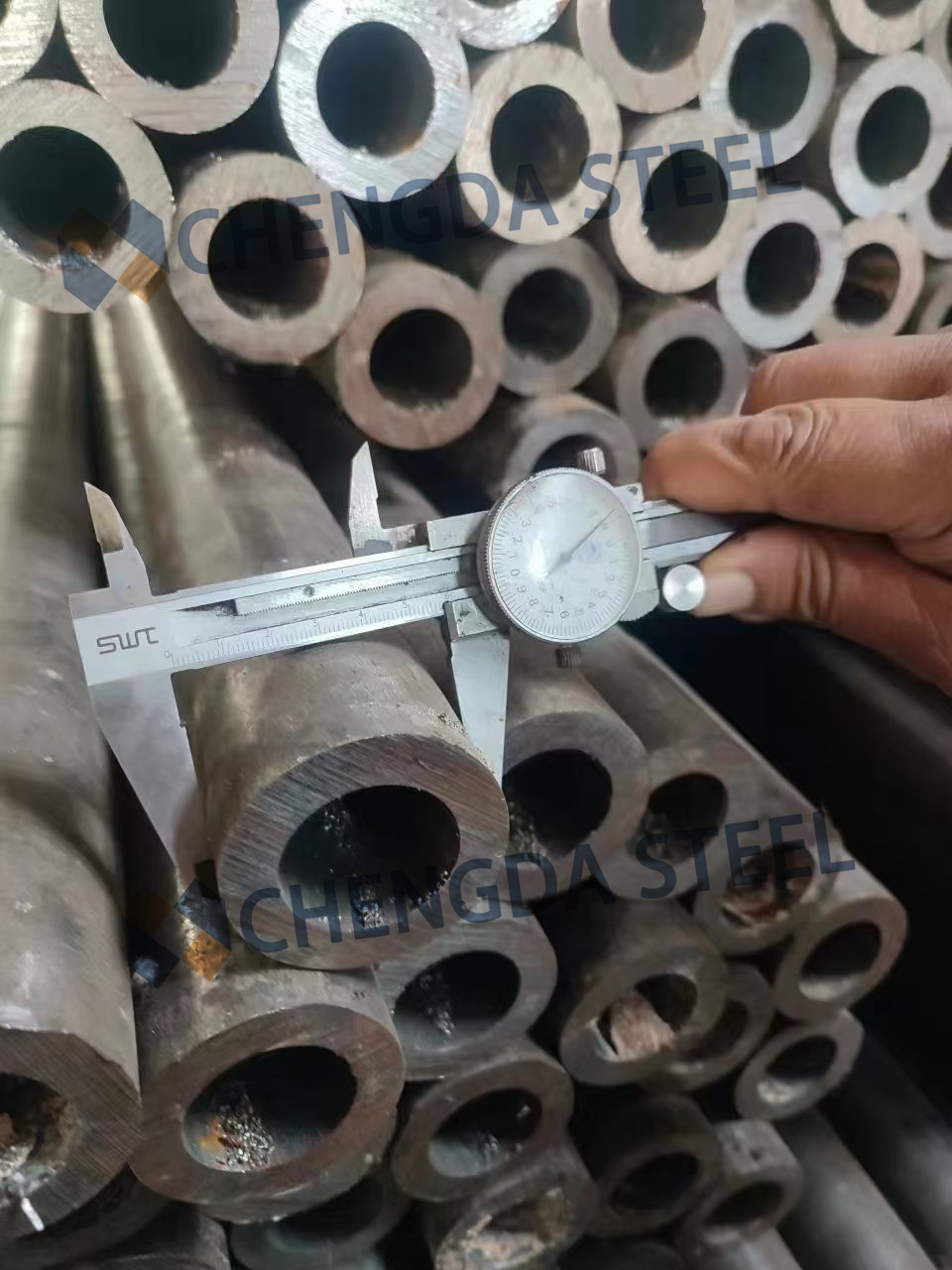
Product introduction
Grade Q235 is the most widely used carbon structural steel in China. The "Q" stands for Yield Strength (Qu fu dian) in Chinese pinyin, and "235" indicates the minimum yield strength of 235 MPa at thickness ≤ 16mm. It is a general-purpose, low-cost steel known for its good plasticity, toughness, and weldability, forming the backbone material for vast construction, engineering, and light-to-medium duty manufacturing.
Q235's composition is governed by GB/T 700-2006 "Carbon Structural Steels". Unlike high-quality steels (GB/T 699), its chemical requirements are less stringent, focusing primarily on meeting mechanical property targets. Key distinctions are its Quality Grades (A, B, C, D) which differ in deoxidation method and impact toughness.
| Element | Standard Requirement (%, Max., for Grade A/B)* | Typical Range (%) | Role and Impact Analysis |
|---|---|---|---|
| Carbon (C) | ≤ 0.22 (A, B) | 0.14 ~ 0.20 | Provides basic strength. Lower max. C than 20# steel ensures better weldability and ductility. Actual C content is often lower to meet yield strength target economically. |
| Manganese (Mn) | ≤ 1.40 | 0.30 ~ 0.65 | Solid solution strengthener. Content adjusted to meet mechanical specs. |
| Silicon (Si) | ≤ 0.35 | ≤ 0.30 | Deoxidizer. Content varies with deoxidation method (killed, semi-killed, rimmed). |
| Phosphorus (P) | ≤ 0.045 (A) / ≤ 0.040 (B) | ≤ 0.035 | Harmful impurity. Limits are higher than in优质钢 (quality steels). Grade C/D have stricter limits (≤0.035/0.030). |
| Sulfur (S) | ≤ 0.050 (A) / ≤ 0.045 (B) | ≤ 0.035 | Harmful impurity. Higher allowable limits than quality steels affect toughness and weldability. Grade C/D have stricter limits (≤0.035/0.030). |
| Key Material Characteristics: | 1. ordinary Carbon Steel: It is a "commodity" steel where mechanical properties are guaranteed, but chemistry can vary. 2. Quality Grades Matter: • Q235A: No impact test, highest P/S limits. For general structures. • Q235B: Room temp (20°C) impact test required. Most common grade. • Q235C / Q235D: Require impact test at 0°C and -20°C respectively, with lower P/S. For more important/welded structures or slight low-temperature service. 3. Deoxidation: Grade B,C,D are typically Fully Killed (镇静钢), better for welding. Grade A can be rimmed. |
Properties are thickness-dependent. Key values are for the most common thickness range (≤16mm) of the most common grade, Q235B.
| Property (for Q235B, t ≤ 16mm) | Standard Requirement | Typical / Range | Engineering Significance |
|---|---|---|---|
| Yield Strength (ReH) | ≥ 235 MPa | 235 - 300 MPa | The defining property. Adequate for most light structural and static loads. Lower than 20# steel (≥245 MPa). |
| Tensile Strength (Rm) | 370 - 500 MPa | 380 - 450 MPa | Provides a safety margin over yield. |
| Elongation (A) | ≥ 26% | 28% - 35% | Excellent ductility. Facilitates cold bending, forming, and energy absorption. A key advantage. |
| Yield-to-Tensile Ratio | - | ~0.60 - 0.65 | Low Y/T ratio indicates large plastic deformation capacity before necking, a safe failure mode. |
| Impact Energy (KV2, 20°C) | ≥ 27 J (B grade) | 40 - 80 J | Meets basic toughness requirements for general use. |
| Hardness | - | ~120 - 150 HB | Very soft, excellent for cold shearing, punching, and machining. |
Key Performance Summary: Q235's strengths are low cost, excellent cold formability, and good weldability. Its weaknesses are relatively low strength, poor hardenability (cannot be strengthened by heat treatment), and variable quality due to relaxed chemistry controls. It is not suitable for high-stress, fatigue-critical, or heat-treated components.
No direct, exact equivalent exists internationally due to Q235's unique quality-grade system and property-focused specification. The closest functional analogs are:
| Country/Standard System | Closest Grade / Analogy | Standard | Key Differences & Notes |
|---|---|---|---|
| United States | ASTM A36 | ASTM A36/A36M | The closest functional equivalent. Similar min. yield (250 MPa/36 ksi), tensile strength, and widespread use in construction. However, A36 has stricter S/P limits (≤0.05% each), making it generally of higher quality than Q235A/B. |
| Europe | S235JR, S235J0, S235J2 | EN 10025-2 | The correct series for comparison. The "235" denotes min yield. Suffixes indicate impact toughness: JR (20°C, like Q235B), J0 (0°C, like Q235C), J2 (-20°C, like Q235D). Chemistry and property requirements are more aligned. |
| Japan | SS400 | JIS G3101 | Functional equivalent, but beware: SS400 is specified by tensile strength (400+ MPa), not yield strength. Its typical yield is ~245 MPa, similar to Q235. It is a commodity structural steel. |
| International | E235 (Fe 360) | ISO 630 | Similar designation system to the European EN standards. |
⚠️ Critical Usage and Design Notes:
Application Domain: Primarily used in building frames, steel structures, brackets, guards, non-critical machine frames, rebar, and general fabrication where high strength is not required.
Weldability: Generally good due to low C. Always specify Grade B, C, or D for welded structures as they are killed steels and have better composition control. Prefer Grade C/D for more important welds.
Limitations & "Do Not Use For":
Heat-treated or high-strength parts.
Critical dynamic/cyclic loading components (low fatigue strength).
Low-temperature service (unless Grade D is used and carefully evaluated).
Pressure vessels or boilers (use dedicated steels like Q245R/Q345R per GB 713).
Important shafts or gears (use 45# or alloy steels).
Material Substitution: In many non-critical applications, Q235B and ASTM A36 are considered commercially interchangeable. For code-controlled projects, formal approval based on certified test reports is required.
Purchasing Tip: Always specify the grade (A, B, C, D). "Q235" alone defaults to the lowest Grade A. For most purposes, Q235B is the minimum recommended specification.
Conclusion: Q235 is the economic workhorse of China's structural steel landscape. Its value lies in its low cost and excellent manufacturability for static, low-stress applications. Engineers must understand its quality grade system and clearly specify (e.g., Q235B) to ensure adequate performance. For international projects, S235JR (Europe) or ASTM A36 (US) serve as the closest practical substitutes, though direct equivalence should be verified via mill test certificates. For any application involving dynamic loads, impact, or low temperatures, stronger or more ductile grades like Q355 (old Q345) should be considered.
Just like you, 70% customers choose long-term cooperation with BBN steel not only for our good product and service quality, good reputation in the international market, but also for our experienced one-stop raw material supply and further steel processing!
Shandong Chengda Steel Co., Ltd.

 Language

 Online Contact Us


