



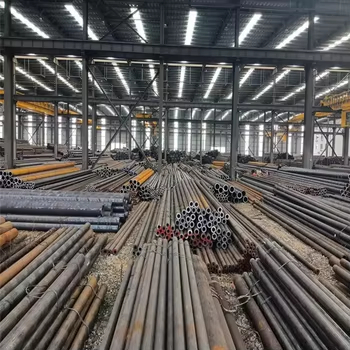
Product introduction
Grade Q355 is the most important and widely used low-alloy high-strength structural steel (HSLA) in China. It succeeded the older designation Q345 in the updated GB/T 1591-2018 standard. The "Q" stands for Yield Strength, and "355" indicates the minimum yield strength of 355 MPa for thicknesses ≤ 16mm. It represents the optimal balance between significantly increased strength, good weldability, and moderate cost, making it the default choice for modern heavy-duty structures and machinery.
Governed by GB/T 1591-2018 "High strength low alloy structural steels", Q355 achieves its higher strength primarily through micro-alloying with elements like Niobium (Nb), Vanadium (V), and Titanium (Ti), along with controlled rolling (TMCP process).
| Element | General Requirement (%) | Role and Impact Analysis |
|---|---|---|
| Carbon (C) | ≤ 0.24 | Controlled at a low level to ensure good weldability and toughness despite the higher strength. The carbon equivalent (CEV/Pcm) is strictly limited. |
| Manganese (Mn) | ≤ 1.60 | Primary solid solution strengthener. Higher content than Q235 significantly contributes to strength and hardenability. |
| Silicon (Si) | ≤ 0.55 | Deoxidizer and solid solution strengthener. |
| Micro-Alloying (Nb, V, Ti) | Small additions (e.g., Nb≤0.11%, V≤0.12%) | The core technology. These elements form fine carbonitride precipitates during controlled rolling/thermomechanical processing. They refine grain size and provide precipitation hardening, enabling high strength without high carbon content. |
| Phosphorus (P) & Sulfur (S) | Very low (e.g., ≤0.025) | Stricter limits than Q235 for better toughness and weldability. |
| Key Material Characteristic: | 1. Micro-alloyed HSLA Steel: Strength comes from grain refinement and precipitation, not high carbon. This yields an excellent strength-toughness-weldability triad. 2. Quality Grades: Defined by impact toughness at different temperatures: • Q355B: 20°C impact. • Q355C: 0°C impact. • Q355D: -20°C impact. • Q355E: -40°C impact. (Most stringent) 3. Delivery Condition: Often supplied in the Thermomechanically Controlled Process (TMCP) or normalized condition, which optimizes the microstructure. |
Properties are thickness-dependent. Values below are for the most common thickness (≤16mm) and grade Q355B.
| Property (for Q355B, t ≤ 16mm) | Standard Requirement | Typical / Range | Engineering Significance |
|---|---|---|---|
| Yield Strength (ReH) | ≥ 355 MPa | 355 - 420 MPa | ~50% higher than Q235. Enables lighter, stronger structures (weight reduction), higher load capacity, and use in more demanding applications. |
| Tensile Strength (Rm) | 470 - 630 MPa | 500 - 580 MPa | High tensile strength provides a robust safety margin. |
| Elongation (A) | ≥ 22% | 24% - 30% | Maintains good ductility for cold forming and energy absorption, though slightly lower than Q235 due to higher strength. |
| Yield-to-Tensile Ratio | - | ~0.70 - 0.80 | A balanced ratio, indicating good plastic deformation capacity and a safe failure mode. |
| Impact Energy (KV2) | ≥ 34 J at specified temp (e.g., 20°C for B) | 50 - 120 J | Superior toughness compared to Q235, especially at lower temperatures for grades C/D/E. Critical for bridges, offshore structures, and dynamic loads. |
| Key Performance Summary: Q355's primary advantage is delivering substantially higher strength (~50% increase) without a proportional sacrifice in toughness or weldability. It is the material of choice when weight savings, load capacity, or structural efficiency are key design drivers. |
Q355 has well-established, nearly exact equivalents in major international standards.
| Country/Standard System | Equivalent Grade | Standard | Notes & Verification Points |
|---|---|---|---|
| United States | ASTM A572 Grade 50 | ASTM A572/A572M | The closest US equivalent. Min. Yield = 50 ksi (345 MPa), slightly lower nominal but functionally identical in design. Also similar to ASTM A992 for structural shapes. |
| Europe | S355JR, S355J0, S355J2, S355K2 | EN 10025-2 | The direct counterpart series. The "355" is aligned. Suffixes indicate impact toughness: JR (20°C), J0 (0°C), J2 (-20°C), K2 (-20°C, higher toughness). Chemistry and properties are highly aligned. |
| Japan | SM490YA, SM490YB | JIS G3106 | SM490 denotes min. Tensile 490 MPa. Grades A/B/C correspond to different impact requirements. A close functional match. |
| International | E355 (Fe 510) | ISO 630 | Similar to EN standards. |
⚠️ Critical Usage and Design Notes:
Application Domain: The mainstream material for:
Heavy steel structures (factory buildings, stadiums, high-rises).
Bridges, offshore platforms, transmission towers.
Heavy machinery frames, crane booms, mining equipment.
Pressure vessels & boilers (specifically Q355R per GB 713).
High-stress structural components in vehicles and ships.
Welding: Weldability is good but requires more care than Q235. Must use matching strength electrodes (e.g., E50 series). Preheating may be required for thick sections or in cold weather to control cooling rate and prevent cold cracks. Always refer to the Carbon Equivalent (CEV) value from the mill certificate.
Material Selection Logic:
Use Q235 for: Light structures, non-critical supports, cost-sensitive projects with low load demands.
Upgrade to Q355 for: Primary load-bearing structures, dynamic/vibrational loads, weight-optimized designs, and applications requiring better low-temperature toughness.
Purchasing & Specification: Always specify the quality grade (B, C, D, E). For most structural work in temperate climates, Q355B is standard. For welded bridges or structures in cold regions (-20°C), Q355D is typical. For critical Arctic applications, specify Q355E.
Difference from Q345: Q355 is the new name for Q345 per the 2018 standard update. The minimum yield strength requirement is essentially unchanged, but the new standard has stricter controls on phosphorus, sulfur, and carbon equivalent, making Q355 generally of higher and more consistent quality than old Q345.
Conclusion: Q355 is the benchmark high-strength structural steel in modern Chinese engineering. It effectively replaces Q235 in all but the most cost-driven or lightly loaded applications. Its success lies in the sophisticated use of micro-alloying and controlled processing to break the traditional strength-toughness trade-off. For engineers, specifying Q355B/D and its international equivalents (S355JR/J2, A572 Gr.50) is a fundamental step in designing safe, efficient, and economical steel structures.
Just like you, 70% customers choose long-term cooperation with BBN steel not only for our good product and service quality, good reputation in the international market, but also for our experienced one-stop raw material supply and further steel processing!
Shandong Chengda Steel Co., Ltd.
 Language

 Online Contact Us


