



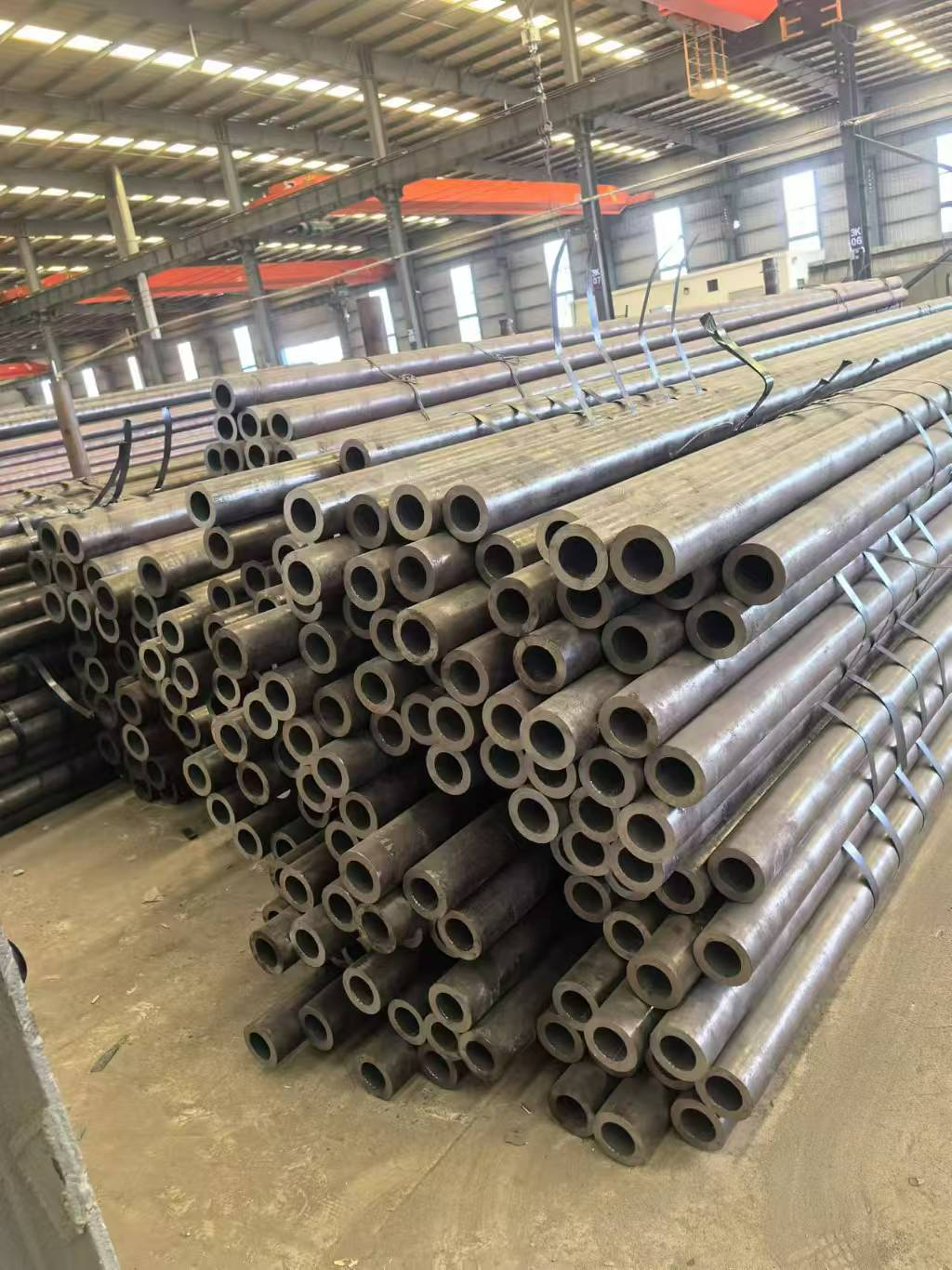
Product introduction
Grade Q345 is the most classic, historically significant, and widely recognized high-strength low-alloy structural steel in China. According to the latest GB/T 1591-2018 standard, its designation has been officially updated to Q355 to align with international standards (e.g., European S355). However, the name "Q345" remains deeply ingrained and is still widely used in daily communication, existing drawings, and technical documentation.
The core of Q345's chemical design lies in "low carbon equivalent + micro-alloying" to achieve a balance between high strength and good weldability.
| Element | Standard Requirement (GB/T 1591-2008, %) | Typical Range (%) | Role and Impact Analysis |
|---|---|---|---|
| Carbon (C) | ≤ 0.20 | 0.15 ~ 0.18 | The foundational element for strength. Kept low to ensure excellent weldability; the Carbon Equivalent (Ceq) is a key control parameter. |
| Manganese (Mn) | ≤ 1.70 | 1.20 ~ 1.50 | The primary solid solution strengthener, significantly increasing strength while improving toughness. |
| Silicon (Si) | ≤ 0.55 | 0.20 ~ 0.50 | Deoxidizer and solid solution strengthener. |
| Niobium (Nb) / Vanadium (V) / Titanium (Ti) | Trace additions | (Nb: 0.015~0.050) | The heart of micro-alloying. These elements form fine carbonitrides during rolling or heat treatment, providing significant "precipitation strengthening" and "grain refinement"—the main reasons for achieving the high strength grade. |
| Phosphorus (P) | ≤ 0.035 | ≤ 0.025 | Harmful impurity; limits are stricter in the new standard. |
| Sulfur (S) | ≤ 0.035 | ≤ 0.020 | Harmful impurity; limits are stricter in the new standard. |
| Key Characteristics: | 1. Quality Grade Classification: This is its core feature. • Q345A: No impact toughness requirement. • Q345B: Requires ≥ 34J at 20°C (most commonly used). • Q345C: Requires impact toughness at 0°C. • Q345D: Requires impact toughness at -20°C (for important welded structures and low-temperature service). • Q345E: Requires impact toughness at -40°C. 2. Delivery Condition: Can be hot-rolled, thermomechanically controlled processed (TMCP), or normalized. TMCP delivers superior comprehensive properties. |
Its properties are also strongly dependent on thickness and quality grade. The following data is for the most common specification: Q345B, thickness ≤16mm.
| Property (Q345B, t ≤ 16mm) | Standard Requirement (GB/T 1591-2008) | Typical Value / Range | Engineering Significance |
|---|---|---|---|
| Yield Strength (ReL) | ≥ 345 MPa | 345 - 400 MPa | The defining property. Approximately 50% stronger than Q235, enabling structural lightweighting and increased load capacity. |
| Tensile Strength (Rm) | 470 - 630 MPa | 500 - 580 MPa | High tensile strength provides ample safety margin. |
| Elongation (A) | ≥ 21% | 22% - 28% | Maintains good plasticity, allowing for cold bending and providing warning through deformation before overload failure. |
| Yield-to-Tensile Ratio (ReL/Rm) | - | 0.69 - 0.78 | A moderate ratio indicates good plastic deformation capacity after yielding, benefiting seismic resistance and safety. |
| Impact Energy (KV2) | ≥ 34 J (20°C) | 50 - 120 J | Grade B meets general toughness requirements. Grades C, D, E offer progressively better low-temperature toughness. |
| Key Performance Summary: The success of Q345/Q355 lies in its exceptional overall balance of strength, toughness, weldability, and cost. It bridges the gap between ordinary carbon steel (Q235) and more expensive alloy steels. |
Q345/Q355 has well-established, nearly exact equivalents in major international standards.
| Country/Standard System | Equivalent Grade | Standard | Notes & Verification Points |
|---|---|---|---|
| United States | ASTM A572 Grade 50 | ASTM A572/A572M | The closest US equivalent. Minimum Yield = 50 ksi (~345 MPa). Also similar to ASTM A992 for structural shapes. |
| Europe | S355JR, S355J0, S355J2 | EN 10025-2 | The direct counterpart series. The "355" denotes min. yield. Suffixes indicate impact toughness: JR (20°C), J0 (0°C), J2 (-20°C). |
| Japan | SM490YA, SM490YB | JIS G3106 | SM490 indicates minimum tensile strength of 490 MPa. Grades A/B/C correspond to different impact requirements. A close functional match. |
| International | E355 (Fe 510) | ISO 630 | Similar to EN standards. |
⚠️ Critical Usage and Design Notes:
Primary Applications: The mainstream material for:
Heavy building structures, bridges, stadiums.
Machinery frames, crane booms, mining equipment.
Pressure vessels & boilers (specifically Q345R per GB 713, now Q355R).
Vehicle frames and shipbuilding components.
Welding: Weldability is good but requires more care than Q235. Use matching strength electrodes (e.g., E50 series). Preheating may be necessary for thick sections or in cold environments to prevent cold cracking. Always consult the CEV from the mill certificate.
The Q345 to Q355 Transition: Q355 is the new designation for Q345. While the minimum yield strength remains essentially the same, the 2018 standard imposes stricter controls on P, S, and Carbon Equivalent, making Q355 generally of higher and more consistent quality than the older Q345. In new designs, Q355 should be specified.
Material Selection Logic:
Use Q235: For light structures, non-critical supports, very cost-sensitive projects.
Use Q345/Q355: For primary load-bearing members, dynamic loads, weight-sensitive designs, and applications requiring better low-temperature toughness (specify Grade D or E).
Procurement: Always specify the quality grade (A, B, C, D, E). For general structural use in temperate climates, Q345B / Q355B is standard. For important welded structures in cold regions, specify Q345D / Q355D or higher.
Conclusion: Q345 (now Q355) is the cornerstone high-strength structural steel in Chinese engineering. It effectively supersedes Q235 in all but the most lightly loaded applications. Its success is built on micro-alloying and modern processing techniques. For engineers, specifying Q345B/D (Q355B/D) and its international equivalents (S355JR/J2, A572 Gr.50) is fundamental to designing safe, efficient, and economical steel structures. When creating new documents, adopting the Q355 designation is recommended for international alignmen
Just like you, 70% customers choose long-term cooperation with BBN steel not only for our good product and service quality, good reputation in the international market, but also for our experienced one-stop raw material supply and further steel processing!
Shandong Chengda Steel Co., Ltd.
 Language

 Online Contact Us


