


Product introduction
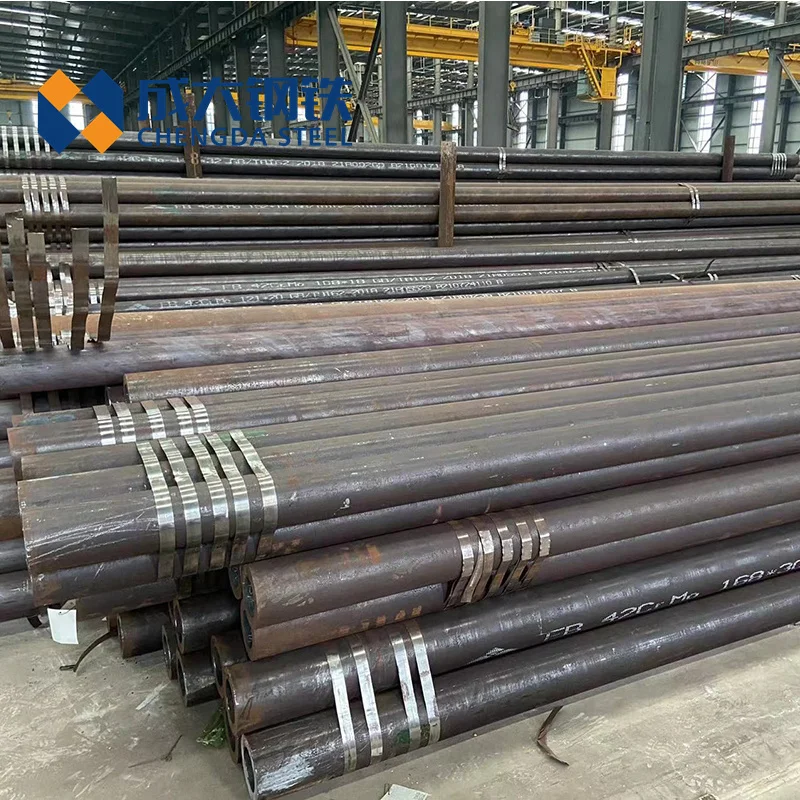
Grade 40Cr is a quintessential alloy structural steel in China, classified under the GB/T 3077 standard. The "40" indicates a carbon content of about 0.40%, and "Cr" denotes the primary alloying element, Chromium. It is the most common and representative of the Cr-series alloy steels, prized for its excellent comprehensive mechanical properties after heat treatment—significantly superior to plain carbon steels like 45#.
The composition of 40Cr is defined by GB/T 3077-2015 "Alloy structural steels". Its design centers on using Chromium to dramatically improve hardenability and strength.
| Element | Standard Requirement (%) | Typical Range (%) | Role and Impact Analysis |
|---|---|---|---|
| Carbon (C) | 0.37 ~ 0.44 | 0.38 ~ 0.42 | Provides the base strength and enables the formation of high-hardness martensite upon quenching. The level is similar to 45# steel. |
| Chromium (Cr) | 0.80 ~ 1.10 | 0.90 ~ 1.05 | The defining alloying element. • Greatly increases hardenability, allowing thick sections to be fully hardened. • Improves strength and toughness after tempering. • Enhances wear resistance and provides modest improvement in corrosion resistance (not stainless). |
| Manganese (Mn) | 0.50 ~ 0.80 | 0.60 ~ 0.75 | Works synergistically with Cr to further improve hardenability and strength. |
| Silicon (Si) | 0.17 ~ 0.37 | 0.20 ~ 0.35 | Deoxidizer and solid solution strengthener. |
| Key Material Characteristic: | 1. Medium-Carbon, Low-Chromium Alloy Steel: Its core advantage over 45# steel is depth of hardening. A 40Cr shaft can be hardened throughout its cross-section, whereas 45# may only have a hard surface and a soft core. 2. Hardenability Steel: It is specifically designed to respond well to Quenching and High-Temperature Tempering (调质处理), achieving a fine tempered sorbite structure. 3. Weldability: Poor. Requires strict preheating, low-hydrogen processes, and post-weld heat treatment to avoid cracking. |
The true potential of 40Cr is only realized after proper heat treatment. The following data is for the Quenched and Tempered (调质) condition with a medium-sized sample diameter (~25mm).
| Property (After Q&T) | Typical Value / Range | Engineering Significance |
|---|---|---|
| Yield Strength (Rp0.2) | ≥ 785 MPa | Exceptionally high—more than double that of normalized 45# steel and ~30% higher than quenched & tempered 45#. Enables design of smaller, lighter, yet stronger components. |
| Tensile Strength (Rm) | 980 - 1180 MPa | Provides a very high ultimate strength margin. |
| Elongation (A) | ≥ 9% | Ductility is adequate for its strength class but lower than lower-strength steels. Indicates some plastic deformation capacity. |
| Reduction of Area (Z) | ≥ 45% | Maintains good resistance to localized necking. |
| Impact Energy (KU2) | ≥ 47 J | Good toughness for a high-strength material, crucial for withstanding shock loads. |
| Hardness | ~220 - 280 HB | Can be directly used in this condition for many parts. For higher surface hardness, subsequent surface hardening (induction, carburizing) is applied. |
| Fatigue Strength | High | Chromium contributes to a significant improvement in fatigue resistance, making it ideal for rotating parts like shafts and gears. |
| Key Performance Summary: After quenching and tempering, 40Cr achieves an outstanding combination of high strength, good toughness, and high fatigue limit. It bridges the gap between cost-effective carbon steels and expensive high-alloy steels. |
40Cr has direct and well-established equivalents in major international standards.
| Country/Standard System | Equivalent Grade | Standard | Key Notes |
|---|---|---|---|
| China | 40Cr | GB/T 3077 | The baseline grade. |
| United States | 5140 | ASTM A29/A29M, ASTM A322 | The direct equivalent. UNS G51400. Same Cr content. "51" denotes a Cr steel with ~1% Cr. |
| Europe (Germany) | 1.7035, 41Cr4 | EN 10083-2 | 41Cr4 (1.7035) is essentially identical. The "4" after Cr indicates ~1% Cr content. |
| Japan | SCr440 | JIS G4105 | The standard equivalent in the Cr steel series. |
| International | 41Cr4 | ISO 683-18 | Consistent with the European standard. |
⚠️ Critical Usage and Design Notes:
Heat Treatment is Non-Negotiable: Components must be designed for and supplied in the quenched and tempered (调质) condition. The specified mechanical properties are unattainable in the as-rolled or normalized state.
Primary Applications: The go-to material for medium-to-highly stressed dynamic components:
Gears (automotive transmissions, machinery)
Shafts (crankshafts, camshafts, spindle shafts)
Bolts and studs for high-pressure connections
Pins, connecting rods, and other critical linkage components.
Surface Hardening: Often used as a substrate for surface hardening processes like induction hardening or nitriding to create a hard, wear-resistant surface while maintaining a tough core.
Machining: Machinability in the annealed state is fair. In the hardened state (Q&T), it is more difficult and requires appropriate tooling.
Limitations: Not a corrosion-resistant steel. For corrosive environments, stainless steels (e.g., 30Cr13) are required. Not suitable for very high-temperature service (>500°C).
Comparison with 45# Steel: This is a key decision point.
For small parts (<~20mm diameter), 45# steel after Q&T may suffice and is cheaper.
For larger parts, complex shapes, or where superior fatigue strength and core hardness are critical, 40Cr is the clear choice despite its higher cost. Its hardenability ensures consistent properties throughout the part.
Conclusion: 40Cr is the workhorse alloy steel for high-performance mechanical components. Its value lies in its reliable response to heat treatment, delivering a level of strength, toughness, and fatigue resistance that carbon steels cannot match for larger sections. When specifying, engineers must mandate the quenched and tempered condition and select the appropriate international equivalent (5140 in the US, 41Cr4 in Europe) for global sourcing. It represents the first and most cost-effective step up from carbon steels into the realm of alloy steels for demanding applications.
Just like you, 70% customers choose long-term cooperation with BBN steel not only for our good product and service quality, good reputation in the international market, but also for our experienced one-stop raw material supply and further steel processing!
Shandong Chengda Steel Co., Ltd.
 Language

 Online Contact Us


