



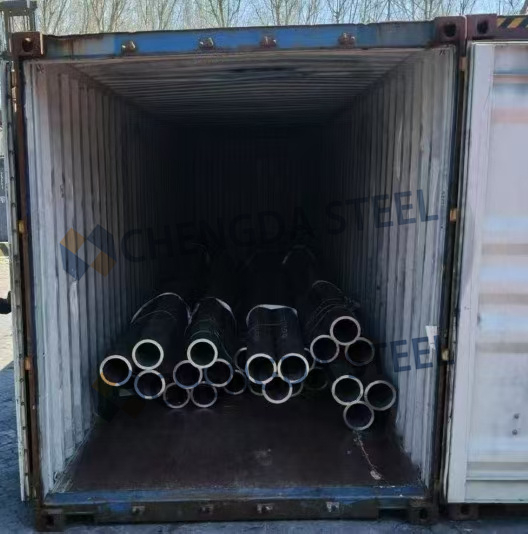
Product introduction
Grade 16Mn is the classic and historical designation for what is now standardized as Q345 low-alloy high-strength structural steel in China. The name "16Mn" follows the old Chinese naming convention: "16" indicates approximately 0.16% carbon content, and "Mn" denotes Manganese as the primary alloying element. It represents the foundational generation of micro-alloyed high-strength steels in China and remains deeply ingrained in engineering language despite the official transition to the "Q" series designation.
The chemical composition of 16Mn is defined by the older standard GB/T 1591-1994 and its successors. Its core principle is "carbon-manganese base with potential micro-alloying."
| Element | Typical Requirement (GB/T 1591-94, %) | Role and Impact Analysis |
|---|---|---|
| Carbon (C) | 0.12 ~ 0.20 | Provides base strength while maintaining acceptable weldability. Lower than in plain carbon steels of similar strength. |
| Manganese (Mn) | 1.20 ~ 1.60 | The key strengthening element. Provides significant solid solution strengthening and improves hardenability, enabling the higher yield strength compared to Q235. |
| Silicon (Si) | 0.20 ~ 0.55 | Deoxidizer and solid solution strengthener. |
| Vanadium (V) / Niobium (Nb) | Sometimes added | In modified or higher-quality versions, these micro-alloying elements were added for grain refinement and precipitation strengthening, improving toughness and strength. |
| Phosphorus (P) | ≤ 0.045 | Harmful impurity. |
| Sulfur (S) | ≤ 0.045 | Harmful impurity. |
| Key Material Characteristic: | 1. C-Mn Steel Foundation: 16Mn established the basic formula for Chinese HSLA steel: moderate carbon + high manganese. 2. Transition to Q345: The official standard evolved, and 16Mn was formally replaced by Q345 in GB/T 1591-2008. The "Q345" designation directly indicates the minimum yield strength (345 MPa). 3. Quality Grades: Under the Q345 system, the material is classified by impact toughness: Q345A (no impact), B (20°C), C (0°C), D (-20°C), E (-40°C). |
Its primary advantage over Q235 is the ~50% increase in yield strength. Properties are thickness-dependent.
| Property (For thickness ≤ 16mm) | Typical Value (16Mn / Q345B) | Engineering Significance |
|---|---|---|
| Yield Strength (ReL) | ≥ 345 MPa | The defining improvement. Allows for lighter structures, higher load capacity, and material savings compared to Q235. |
| Tensile Strength (Rm) | 470 - 630 MPa | Provides a good safety margin. |
| Elongation (A) | ≥ 21% | Maintains good ductility for forming and bending. |
| Yield-to-Tensile Ratio | ~0.65 - 0.75 | A favorable ratio indicating good plastic deformation capacity. |
| Impact Energy (KV2) | ≥ 34J (at 20°C for B grade) | Adequate toughness for general structural use. Higher grades (C,D,E) offer superior low-temperature toughness. |
| Key Performance Summary: 16Mn/Q345 provides an optimal balance of significantly higher strength, good formability, and acceptable weldability at a reasonable cost. It became the workhorse steel for Chinese heavy industry and construction. |
As the predecessor to Q345, its international equivalents are the same.
| Country/Standard System | Equivalent Grade | Standard |
|---|---|---|
| Europe | S355JR, S355J2, etc. | EN 10025-2 |
| United States | ASTM A572 Grade 50 | ASTM A572/A572M |
| Japan | SM490 | JIS G3106 |
| International | E355 | ISO 630 |
⚠️ Critical Usage and Design Notes:
Modern Designation: In all new designs, specifications, and procurement, the official term Q345 should be used, along with the required quality grade (B, C, D, E). "16Mn" is considered obsolete in formal contexts.
Primary Applications: Its uses are identical to Q345:
Building and bridge structures
Heavy machinery frames and vehicles
Pressure vessels & boilers (using the special quality Q345R per GB 713)
Storage tanks, transmission towers
Welding: Requires more care than Q235. Must use matching strength electrodes (E50 series). Preheating is recommended for thick sections (>25mm) or in low ambient temperatures to prevent cold cracks.
Comparison with Q235:
Strength: Q345 is ~50% stronger.
Cost: Q345 is 10-20% more expensive.
Decision Rule: Use Q235 for non-critical, lightly loaded structures. Upgrade to Q345 (16Mn) for primary load-bearing members where weight savings or higher capacity justify the cost.
Historical Context: The widespread adoption of 16Mn in the 20th century was a milestone in Chinese metallurgy, enabling more efficient and modern steel structures. Its legacy continues under the Q345 name.
Conclusion:
16Mn is the historic foundation of China's high-strength structural steel industry, now fully embodied in the modern grade Q345. Understanding "16Mn" is key to reading older drawings and technical literature. For all current purposes, engineers should specify Q345 with the appropriate quality grade (e.g., Q345D for important welded structures in cold climates). Its global equivalents (S355, A572 Gr.50) make it a universally recognized material for demanding structural applications. The transition from a chemistry-based name (16Mn) to a property-based name (Q345) reflects the evolution of steel standardization towards performance-oriented specifications.
Just like you, 70% customers choose long-term cooperation with BBN steel not only for our good product and service quality, good reputation in the international market, but also for our experienced one-stop raw material supply and further steel processing!
Shandong Chengda Steel Co., Ltd.
 Language

 Online Contact Us


