



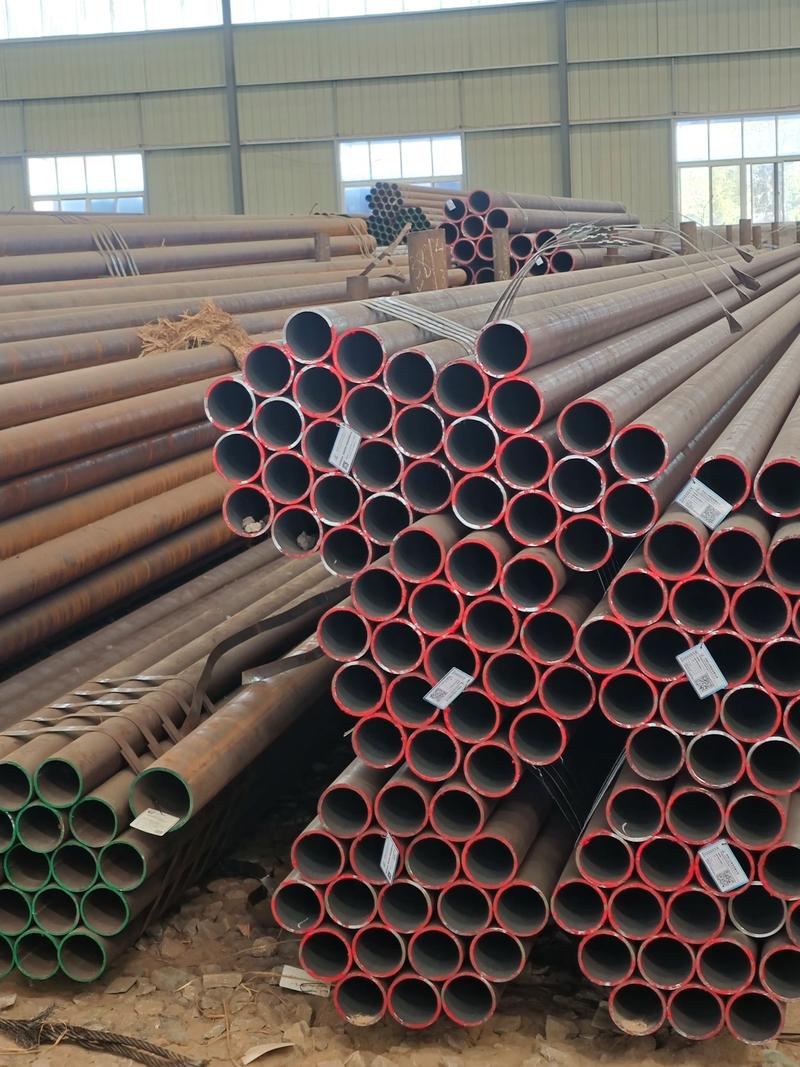
Product introduction
Primary Standard: EN 10025-2: 2019 (Hot rolled products of structural steels - Part 2: Technical delivery conditions for non-alloy structural steels)
Designation Format: S275 + Impact Toughness Symbol + Delivery Condition Symbol
Common Suffix Combinations:
S275JR: Standard quality for general use. JR guarantees a minimum of 27 J impact energy at +20°C.
S275J0: For applications where impact toughness at 0°C is required.
S275J2: For applications requiring guaranteed impact toughness at -20°C.
S275J2+N / S275NL: N indicates normalized rolling. NL indicates normalized delivery with guaranteed low-temperature impact properties (typically -50°C or better). These offer improved toughness.
S275M/ML: M indicates thermo-mechanically rolled delivery, providing a good combination of strength and toughness.
Data is based on EN 10025-2 for the common reference thickness of ≤ 16 mm for plates/sections.
| Property | Value & Requirement | Explanation & Significance |
|---|---|---|
| Yield Strength (ReH) | ≥ 275 MPa | Defines the grade. Provides a ~17% strength increase over S235 (235 MPa), allowing for weight savings or higher load capacity in design. |
| Tensile Strength (Rm) | 410 - 560 MPa | The strength range is shifted higher compared to S235 (360-510 MPa), maintaining a good safety margin between yield and tensile strength. |
| Elongation at Break (A) | ≥ 23% (for thickness ≤40mm, JR grade) | Slightly lower minimum than S235 (≥26%), reflecting the typical strength-ductility trade-off. It still indicates good formability for bending and shaping. |
| Impact Energy (KV) | ≥ 27 J (for JR, at +20°C) | Standard toughness requirement identical to S235JR. Higher grades (J0, J2, NL) ensure performance in colder environments. |
Important Notes:
The 275 MPa minimum yield strength is the key differentiator from S235.
Properties, especially yield strength, decrease with increasing material thickness. For example, S275JR yield strength drops to ≥265 MPa for thicknesses >40mm ≤63mm.
Delivery conditions like Normalizing (+N) or Thermo-Mechanical Rolling (+M) can refine the grain structure, improving both strength and toughness, especially in thicker sections.
S275 has a slightly more controlled and elevated chemistry compared to S235, primarily to achieve the higher strength.
| Element | Typical Range / Max (S275JR) | Role & Analysis |
|---|---|---|
| Carbon (C) | ≤ 0.21% (commonly 0.16-0.18%) | Slightly higher maximum limit than S235 (≤0.17%). The actual carbon content is strategically controlled to contribute to strength while keeping weldability manageable. |
| Manganese (Mn) | ≤ 1.50% | Maximum limit is slightly higher than S235 (≤1.40%). Manganese is a primary, cost-effective strengthener and improves hardenability. |
| Phosphorus (P) | ≤ 0.035% | Same strict control as S235 to prevent cold brittleness. |
| Sulfur (S) | ≤ 0.035% | Same strict control as S235 to prevent hot brittleness. |
| Carbon Equivalent (CEV) | Approx. 0.35 - 0.42% | A critical parameter for welding. S275 has a higher carbon equivalent than S235, indicating a moderate increase in weld hardening and cracking tendency. For thick sections or restrained joints, preheating may be recommended based on specific welding codes (e.g., EN 1011-1). |
Core Material Characteristics:
Balanced Chemistry for Strength: The controlled increase in C and Mn is the primary driver for the higher yield strength.
Weldability Consideration: While still considered good and readily weldable, its higher CEV means welding procedures should be given more attention than for S235, especially for critical joints or thicker materials.
Advantages:
Higher Strength-to-Weight Ratio: The 275 MPa yield strength allows for more efficient designs than S235, potentially reducing material weight and cost in load-bearing elements.
Good Weldability and Formability: Maintains most of the favorable processing characteristics of mild steel, though with slightly more care needed during welding.
Excellent Cost-Benefit Balance: It offers a significant strength upgrade over S235 at a relatively small cost premium, making it a highly economical choice for many structural applications.
Wide Availability: Like S235, it is a commodity steel grade produced globally.
Disadvantages/Limitations:
Moderate Strength: Not suitable for high-performance or heavily stressed structures where S355 or higher grades are required.
Corrosion Resistance: Like all carbon steels, requires surface protection (painting, galvanizing).
Weld Procedure Sensitivity: Requires more stringent welding procedure specifications than S235 to avoid defects in challenging conditions.
Typical Application Fields:
Building & Construction: Primary and secondary load-bearing structures in commercial and industrial buildings (beams, columns, trusses), bridges, and warehouses where S235 is insufficient.
Heavy Machinery & Equipment: Frames, chassis, lifting arms, and support structures for agricultural, mining, and material handling equipment.
Shipbuilding: Used for internal structural members, bulkheads, and hull plates in smaller vessels or non-critical areas of larger ships.
General Fabrication: Any structural component where the designer needs a step up in strength from basic S235 without moving to high-strength, low-alloy (HSLA) steels.
| Feature | S235 | S275 | Implication for Selection |
|---|---|---|---|
| Yield Strength (Min) | 235 MPa | 275 MPa | S275 provides ~17% higher load capacity. Use S275 when S235 sections become too large/heavy. |
| Tensile Strength | 360-510 MPa | 410-560 MPa | S275 has a higher overall strength range. |
| Ductility (Min Elongation) | ≥ 26% | ≥ 23% | S235 has slightly better inherent formability. For severe cold forming, S235 may be preferred. |
| Typical Carbon Content | Lower (≤0.17%) | Slightly Higher (≤0.21%) | Key difference affecting weldability. |
| Carbon Equivalent (CEV) | Low (~0.28-0.35%) | Moderate (~0.35-0.42%) | S235 is "easier" to weld with minimal precautions. S275 requires more formal welding procedures, especially for thick materials or critical joints. |
| Primary Driver | Cost & Formability | Strength & Cost-Balance | Choose S235 for non-critical structures, easy fabrication, and lowest cost. Choose S275 for a stronger, more weight-efficient structure where welding can be controlled. |
Summary: S275 is the natural upgrade path from S235 when increased strength is needed. It occupies a crucial space in the structural steel portfolio, offering a meaningful performance increase with only a modest compromise in fabricability. The choice ultimately hinges on the specific strength requirements of the design and the available fabrication capabilities, particularly regarding welding.
Just like you, 70% customers choose long-term cooperation with BBN steel not only for our good product and service quality, good reputation in the international market, but also for our experienced one-stop raw material supply and further steel processing!
Shandong Chengda Steel Co., Ltd.
 Language

 Online Contact Us


