


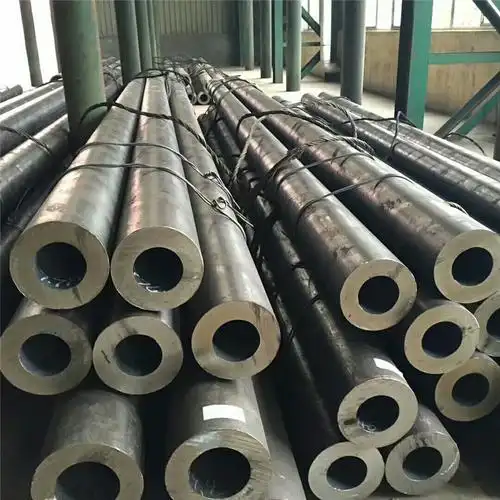
Product introduction
Primary Standards:
EN 10025-2/3/4/6: S420 can be found across these standards, similar to S355, but the higher base strength makes the thermomechanically rolled (+M) and quenched & tempered (+QL) grades far more common and practical than the basic normalized grades.
EN 10149-2: This standard for hot-rolled flat products made of high yield strength steels for cold forming is a key source for S420MC. The "C" stands for "cold forming," and these steels are microalloyed and thermomechanically rolled to achieve high strength with good ductility.
Designation Format: S420 + Subgrade Symbol (+ Delivery Condition)
Key Subgrades & Symbols:
S420MC: The most commonly encountered S420 grade. "MC" = Thermomechanically rolled for Cold forming. Designed for parts that will be significantly formed after rolling.
S420M: Thermomechanically rolled. This is a very common delivery state for this strength level, offering a good balance of properties without separate heat treatment.
S420ML: Thermomechanically rolled with guaranteed low-temperature impact properties (e.g., -50°C).
S420N: Normalized or normalized rolled.
S420NL: Normalized with low-temperature toughness.
S420QL/QL1: Quenched and tempered. Offers the best combination of very high strength and excellent toughness, especially in thicker sections. QL1 often has higher guaranteed impact values.
For structural plates/sections (EN 10025):
For flat products for cold forming (EN 10149):
Data is for typical thicknesses (e.g., t ≤ 16-20 mm for plates; actual guaranteed values vary by thickness and subgrade).
| Property | Value & Requirement (Typical for S420M/QL) | Explanation & Significance |
|---|---|---|
| Yield Strength (ReH) | ≥ 420 MPa | The defining "420" value. Provides an ~18% increase over S355. This allows for further weight reduction, smaller cross-sections, and is crucial for mobile equipment and long-span structures. |
| Tensile Strength (Rm) | 500 - 680 MPa (Range widens with grade) | High tensile strength, but the focus is on the high yield strength. The ratio of yield-to-tensile strength is higher than in lower grades. |
| Elongation at Break (A) | ≥ 18% - 20% | Noticeably lower minimum than S355 (≥22%). This reflects the strength-ductility trade-off. While still ductile, it has less plastic reserve and requires more care during forming. |
| Impact Energy (KV) | Typically ≥ 27-40 J at -20°C or -40°C | Good toughness is still required and achieved through careful alloy design and processing (especially in M/QL grades). NL/ML grades guarantee toughness down to -50°C or lower. |
Critical Notes on Thickness & Grade:
The strength reduction with thickness is more pronounced in high-strength steels. A S420M plate might guarantee 420 MPa up to 30mm, but only 400 MPa for 50mm thickness.
S420MC (for cold forming) has different property guarantees, often with a specified minimum yield strength (e.g., ≥420 MPa) but with a maximum tensile strength also defined to ensure formability.
QL grades are superior for thick sections, as they maintain high yield strength (often 420+ MPa) even in plates over 100mm thick.
S420 requires a more sophisticated chemical design to achieve its strength without becoming brittle. Carbon is controlled, and microalloying is essential.
| Element | Typical Range / Influence | Role & Analysis |
|---|---|---|
| Carbon (C) | ≤ 0.20% (Often lower, especially for MC/QL) | Tightly controlled. Higher carbon is counterproductive for weldability and toughness at this strength level. Strength comes from other means. |
| Manganese (Mn) | Up to ~1.70% | A primary, cost-effective strengthener and austenite stabilizer for the rolling process. |
| Micro-alloys (Nb, V, Ti, possibly Mo) | Strategic additions | Absolutely critical. Used in combination to control grain size during thermomechanical rolling (+M) and to create precipitation hardening. Molybdenum may be added in QL grades to increase hardenability. |
| Phosphorus (P) & Sulfur (S) | ≤ 0.025% or lower | Tighter controls than S355 to ensure good toughness and weldability at high strength levels. |
| Silicon (Si) | ≤ 0.50% | |
| Carbon Equivalent (CEV) | Approx. 0.45 - 0.55%+ (Can be higher for QL grades) | Very high. Welding is a major engineering challenge. Requires strictly qualified procedures (WPS/PQR), mandatory preheating (often at higher temperatures), careful control of heat input, and frequently the use of low-hydrogen or special high-toughness consumables. Post-weld heat treatment (PWHT) may be specified for critical applications. |
Core Material Characteristics:
Advanced HSLA Steel: Achieves strength through a combination of fine-grained ferrite-bainite microstructures (M grades) or tempered martensite/bainite (QL grades).
Fabrication-Led Design: The material cannot be selected independently of the fabrication plan. Welding procedures must be established before material procurement.
Advantages:
Exceptional Strength-to-Weight Ratio: The primary driver. Enables lightweight, high-performance designs.
Good Toughness Available: Through proper grade selection (M, ML, QL), excellent low-temperature toughness can be achieved.
Material Efficiency: Reduces structural weight, which can lower costs in supporting structures, foundations, and transportation, and is beneficial for sustainability.
Disadvantages/Limitations:
High Fabrication Cost & Complexity: Welding is difficult and expensive. Requires highly skilled labor, extensive procedure qualification, and often NDT (ultrasonic testing, X-ray).
Reduced Ductility and Formability: Less forgiving during cold bending or correction of distortions. Special tooling may be needed.
Higher Material Cost: Significantly more expensive per tonne than S355 due to alloying and specialized processing.
Limited Availability: Not all steel service centers stock it, and some subgrades/thicknesses may require mill order lead times.
Typical Application Fields:
Heavy Mobile Equipment: Crane booms, truck frames, trailer chassis, excavator arms – where every kilogram saved translates to higher payload or performance.
Advanced Structural Engineering: Long-span bridge components, high-rise building cores, special architectural elements where minimizing member size is key.
Mining & Quarrying: High-wear, high-stress components, hoppers, and chutes.
Wind Energy: Transition pieces, offshore foundation structures (using S420NL/ML/QL grades).
S420MC Specific: Used for cold-formed profiles in building frames, commercial vehicle components, and any part requiring complex shapes from high-strength sheet/plate.
| Feature | S355 (J2/M) | S420 (M/QL) | Implication for Selection |
|---|---|---|---|
| Yield Strength (Min) | 355 MPa | 420 MPa (~18% increase) | Use S420 when S355 sections are too large/heavy, and weight is a critical design driver. |
| Ductility (Min Elongation) | ≥ 22% | ≥ 18-20% | S355 is more forgiving for on-site adjustments and accidental overloading. |
| Primary Market Role | General-purpose HSLA steel | Specialized high-strength steel | S355 is the default choice. S420 is used for optimized, performance-driven designs. |
| Welding Complexity | Moderate-High (Requires WPS, often preheat) | Very High (Mandatory stringent WPS, higher preheat, potential PWHT) | The largest differentiator. S420 welding costs can outweigh material savings if not managed from the design stage. |
| Carbon Equivalent (CEV) | ~0.40-0.47 | ~0.45-0.55+ | Crack sensitivity is significantly higher for S420. |
| Cost Driver | Material + Controlled Fabrication | Fabrication + Material | For S420, the engineering and welding costs dominate the total part cost. |
| Common Forms | Ubiquitous in all forms (plates, sections, tubes) | More common as plate (S420M/QL) or sheet/coil (S420MC). Rolled sections (beams, angles) in S420 are rare and special. |
Summary: S420 is not simply a "stronger S355." It is a material for optimized engineering. Its use is justified only when the benefits of weight reduction (e.g., increased payload, longer spans, smaller foundations, transportation savings) are quantifiably greater than the substantial increase in material cost and, more importantly, fabrication complexity and cost. Its application is almost always the result of a detailed cost-benefit analysis at the project design phase. The choice between S420M (thermomechanical) and S420QL (quenched & tempered) depends on the required thickness, toughness, and the fabricator's experience with each processing route.
Just like you, 70% customers choose long-term cooperation with BBN steel not only for our good product and service quality, good reputation in the international market, but also for our experienced one-stop raw material supply and further steel processing!
Shandong Chengda Steel Co., Ltd.
 Language

 Online Contact Us


