



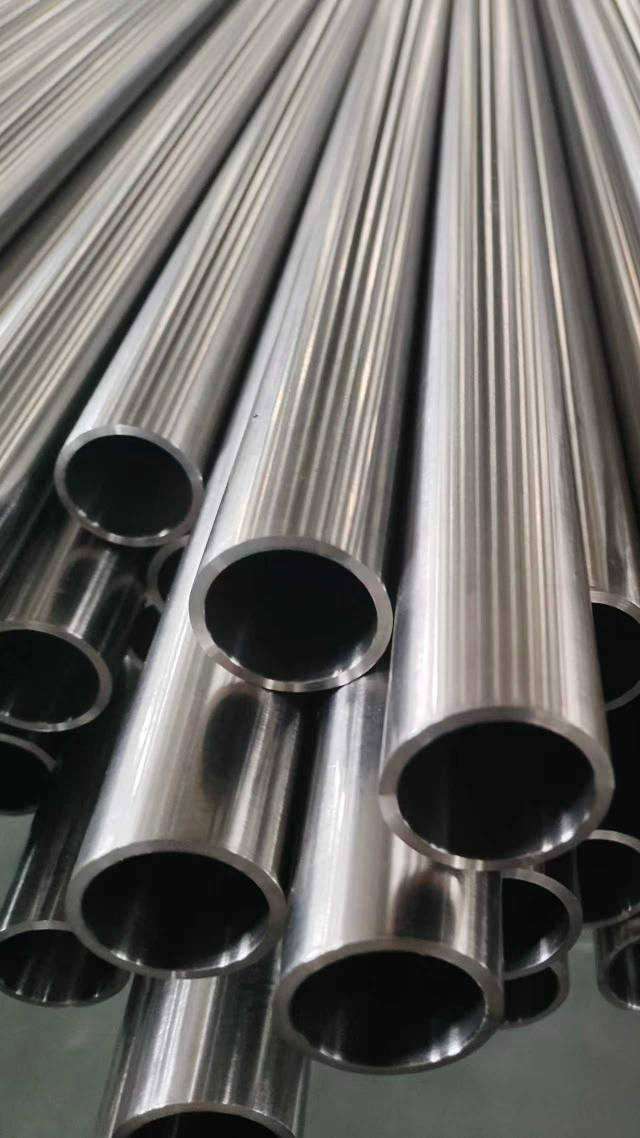
Product introduction
304 stainless steel is the most versatile and widely used austenitic stainless steel. Its excellent combination of corrosion resistance, formability, and weldability makes it a standard choice for a vast range of industrial and consumer applications.
The defining characteristic of 304 is its balanced chemical composition, primarily based on the 18% Chromium (Cr) and 8% Nickel (Ni) "18-8" formula. This composition creates a stable austenitic structure at room temperature, which grants the metal its non-magnetic nature (annealed condition) and excellent toughness.
Typical Chemical Composition (Weight %, ASTM A240/A240M Standard):
| Element | Content (%) | Role & Effect |
|---|---|---|
| Chromium (Cr) | 18.0 - 20.0 | Forms a passive oxide layer for corrosion resistance. The primary element for "stainlessness." |
| Nickel (Ni) | 8.0 - 10.5 | Stabilizes the austenitic microstructure, providing ductility, toughness, and resistance to reducing acids. |
| Carbon (C) | ≤ 0.07 | Kept low to minimize carbide precipitation during welding (which can lead to intergranular corrosion). |
| Manganese (Mn) | ≤ 2.0 | Aids in hot working and contributes to solid solution strength. |
| Silicon (Si) | ≤ 0.75 | Improves oxidation resistance at high temperatures. |
| Phosphorus (P) | ≤ 0.045 | Impurity, kept low to maintain toughness. |
| Sulfur (S) | ≤ 0.030 | Impurity, affects machinability (improves it slightly) and weldability. |
| Iron (Fe) | Balance | The base metal. |
*Note: The low carbon version, 304L (C ≤ 0.03%), is specified for heavy welding to ensure maximum resistance to intergranular corrosion without post-weld heat treatment.*
Structure: Austenitic (Face-Centered Cubic - FCC). This structure is responsible for its high ductility and non-magnetic properties.
Corrosion Resistance: Excellent against a wide range of atmospheric environments, oxidizing acids, and many organic chemicals. It has poor resistance to chloride-induced pitting and crevice corrosion (e.g., in seawater), for which 316 is preferred.
Heat Treatment: It is not hardenable by heat treatment. It can only be softened by annealing (heated to 1010-1120°C, then rapidly cooled) or strengthened by cold working.
The mechanical properties of 304 are highly dependent on its condition—whether it is in the annealed (soft) state or has been cold worked.
| Property | Value / Range | Test Standard | Significance |
|---|---|---|---|
| Tensile Strength (Ultimate) | 515 - 620 MPa | ASTM A370 | The maximum stress the material can withstand before fracture. |
| Yield Strength (0.2% Offset) | 205 MPa (min) | ASTM A370 | The stress at which the material begins to deform plastically (permanently). |
| Elongation (in 50mm) | 40% (min) | ASTM A370 | A measure of ductility. High elongation indicates excellent formability and ability to absorb energy. |
| Hardness (Brinell) | 201 HB (max) | ASTM E10 | Relatively soft in annealed state, making it easy to form and machine. |
| Hardness (Rockwell B) | 92 HRB (max) | ASTM E18 | |
| Modulus of Elasticity | ~193 GPa | - | Measure of stiffness (similar to carbon steel). |
Cold rolling or drawing significantly increases strength and hardness while reducing ductility. This is a primary method to strengthen 304.
Example: Property Variation with Cold Work:
| Condition / Temper | Tensile Strength (MPa) | Yield Strength (MPa) | Elongation (%) |
|---|---|---|---|
| Annealed (Soft) | ~580 | ~290 | ~55 |
| ¼ Hard | ~690 | ~515 | ~25 |
| ½ Hard | ~860 | ~690 | ~12 |
| Full Hard | ~1100 | ~965 | ~7 |
| Property | Value | Condition / Notes |
|---|---|---|
| Density | 8.00 g/cm³ | At 20°C |
| Melting Point | 1400 - 1450 °C | |
| Thermal Expansion | 17.2 μm/m·°C | 20-100°C (Higher than carbon steel) |
| Thermal Conductivity | 16.2 W/m·K | At 100°C (Lower than carbon steel) |
| Electrical Resistivity | 0.72 μΩ·m | At 20°C |
| Magnetic Permeability | ~1.02 (Effectively non-magnetic) | Annealed condition |
Strengths:
Excellent Formability & Weldability: Its high ductility allows for deep drawing, bending, and stretching. It can be readily welded using all common methods.
Good General Corrosion Resistance: Ideal for food processing, kitchen environments, architectural trim, and chemical containers handling mild corrosives.
Hygienic & Aesthetic: Easy to clean, non-porous surface. Can be polished to a high luster.
Good Low-Temperature Toughness: Retains ductility and strength in cryogenic applications.
Limitations:
Moderate Strength (Annealed): Lower yield strength than carbon steels or martensitic stainless steels.
Poor Chloride Resistance: Not suitable for marine or high-chloride environments without risk of pitting.
Subject to Galling: The austenitic structure can be prone to adhesive wear (galling) in threaded or sliding contacts.
Work Hardens Rapidly: This can be an advantage for strengthening but makes machining more difficult, requiring proper techniques and tooling.
Typical Applications Leveraging These Properties:
Chemical: Tanks, piping, and heat exchangers for non-chloride services.
Food & Beverage: Processing equipment, brewing tanks, kitchen sinks, countertops, cookware, and utensils.
Architectural: Wall cladding, handrails, trim, and decorative elements.
Automotive: Exhaust system components (non-critical parts), trim.
Medical: Sterilizable equipment and containers (where high chloride resistance is not critical).
General Industry: Fasteners, springs (made from cold-worked wire), and wire forms.
In conclusion, 304 stainless steel's popularity stems from its well-balanced chemical composition (18-8 Cr-Ni), which directly provides a favorable set of mechanical properties (high ductility, moderate strength, excellent toughness) and functional characteristics (good corrosion resistance, formability, weldability).
Just like you, 70% customers choose long-term cooperation with BBN steel not only for our good product and service quality, good reputation in the international market, but also for our experienced one-stop raw material supply and further steel processing!
Shandong Chengda Steel Co., Ltd.
 Language

 Online Contact Us


