



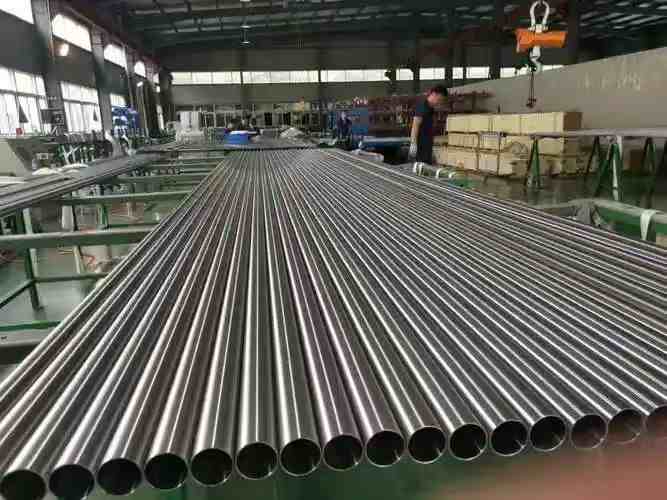
Product introduction
304L is the low-carbon variant of the standard 304 (1.4301) austenitic stainless steel. The "L" stands for "Low Carbon." This subtle but critical compositional change is engineered to maximize resistance to intergranular corrosion, particularly in welded structures and applications involving exposure to high temperatures (450-850°C).
The key difference lies in the maximum allowable carbon content, which is reduced from 0.07% in 304 to 0.03% in 304L. This minimizes the formation of chromium carbides at grain boundaries during welding or high-temperature exposure.
Standard Chemical Composition (Weight %, ASTM A240/A240M):
| Element | 304L (Typical %) | 304 (For Comparison) | Role & Critical Effect |
|---|---|---|---|
| Carbon (C) | ≤ 0.030 | ≤ 0.07 | The defining element. Low carbon prevents harmful chromium carbide (Cr₂₃C₆) precipitation, preventing weld decay. |
| Chromium (Cr) | 18.0 - 20.0 | 18.0 - 20.0 | Provides the passive oxide layer for corrosion resistance. |
| Nickel (Ni) | 8.0 - 12.0 | 8.0 - 10.5 | Stabilizes the austenitic structure, providing ductility and toughness. |
| Manganese (Mn) | ≤ 2.0 | ≤ 2.0 | Aids in hot workability. |
| Silicon (Si) | ≤ 0.75 | ≤ 0.75 | Improves high-temperature oxidation resistance. |
| Phosphorus (P) | ≤ 0.045 | ≤ 0.045 | Impurity. |
| Sulfur (S) | ≤ 0.030 | ≤ 0.030 | Impurity, slightly improves machinability. |
| Iron (Fe) | Balance | Balance | Base metal. |
Equivalent Standards: UNS S30403, EN 1.4307 / 1.4306, SUS 304L
Due to the lower carbon content, 304L has slightly lower yield and tensile strength in the annealed condition compared to standard 304. However, its exceptional ductility and weldability are its primary mechanical advantages.
| Property | 304L Value / Range | 304 (For Comparison) | Test Standard | Implication for 304L |
|---|---|---|---|---|
| Tensile Strength | 485 - 655 MPa | 515 - 620 MPa | ASTM A370 | Slightly lower ultimate strength than 304. Still ample for most applications. |
| Yield Strength (0.2% Offset) | ≥ 170 MPa | ≥ 205 MPa | ASTM A370 | The most notable difference. Lower yield strength means it deforms more easily under load. |
| Elongation (in 50mm) | ≥ 40% | ≥ 40% | ASTM A370 | Excellent and identical ductility. Allows for severe forming and bending. |
| Hardness (Brinell) | ≤ 201 HB | ≤ 201 HB | ASTM E10 | Similar softness in annealed state, good for fabrication. |
| Modulus of Elasticity | ~193 GPa | ~193 GPa | - | Stiffness is identical to 304 and carbon steel. |
Crucial Note on Strengthening: Like 304, 304L cannot be strengthened by heat treatment. It can only be work-hardened through cold working (e.g., cold rolling, drawing). Its work-hardening rate is slightly higher than 304 due to the lower carbon content.
| Aspect | 304L Stainless Steel | Comparison with Standard 304 |
|---|---|---|
| Intergranular Corrosion Resistance | Excellent. Very low risk of "weld decay" in the heat-affected zone (HAZ) after welding. | Superior. 304 is susceptible to carbide precipitation in the HAZ unless rapidly cooled or post-weld annealed. |
| Weldability | Outstanding. Can be welded readily by all standard methods without the need for post-weld annealing, even in heavy sections. | Very Good, but thick welded sections may require post-weld annealing to restore full corrosion resistance. |
| High-Temperature Performance | Better for sustained exposure in 425-860°C range. Lower carbon prevents detrimental carbide formation. | Risk of carbide precipitation in this "sensitization" temperature range, weakening corrosion resistance. |
| General Corrosion Resistance | Identical to 304 in most environments (atmospheric, food, mild chemicals). Not resistant to chlorides. | Identical. |
| Strength (Annealed) | Slightly Lower yield and tensile strength. | Slightly Higher strength due to carbon solid-solution strengthening. |
| Cost | Slightly Higher due to more precise composition control. | Slightly Lower. The industry standard and most readily available. |
USE 304L WHEN:
The component will be welded, especially if it's a thick section (>6mm), and post-weld heat treatment is not practical or economical. This is the most common reason.
The service involves exposure to temperatures in the sensitization range (450-850°C), such as in certain heat exchangers or exhaust systems.
The application has a zero-tolerance risk for intergranular corrosion, even if the environment is only mildly corrosive (e.g., high-purity pharmaceutical or food processing equipment).
You need a single, reliable stock material for a fabrication shop that will be used for both welded and non-welded parts to simplify inventory.
STICK WITH STANDARD 304 WHEN:
The application involves no welding.
Welded sections are thin and cool quickly after welding, minimizing sensitization.
Higher as-fabricated strength (in annealed state) is needed and corrosion conditions are mild.
Cost is a critical driving factor for large, non-welded structures.
Typical Industries & Applications for 304L:
Chemical & Petrochemical: Welded pressure vessels, tanks, and piping for mild corrosives.
Pharmaceutical & Food: Sterilizable tanks, process piping, and fermentation vessels where weld integrity is paramount.
Architectural: Heavy welded structural components for facades and railings.
Heat Exchangers: Components operating in the sensitization temperature zone.
General Fabrication: The preferred choice for workshops producing complex, welded fabrications.
Conclusion: 304L is not "better" than 304 in a general sense; it is specialized for superior performance in welded and high-temperature scenarios where the risk of intergranular corrosion must be eliminated. It trades a small amount of initial strength for vastly improved fabrication safety and long-term integrity in welded constructions. For non-welded applications, standard 304 often remains the more economical and sufficient choice.
Just like you, 70% customers choose long-term cooperation with BBN steel not only for our good product and service quality, good reputation in the international market, but also for our experienced one-stop raw material supply and further steel processing!
Shandong Chengda Steel Co., Ltd.
 Language

 Online Contact Us


